By Frank G. & Edwin H.
Bolivia residency for asset protection: limits

A second residency can solve one problem and create three more if you choose the wrong country. Many investors want lower reporting friction, territorial taxation, and a legal fallback outside their home system. Then they discover slow immigration, apostilles, corporate maintenance, or tax rules that defeat the original goal.
Bolivia stands out because the residency path stays light at the start. For the initial temporary residency, you do not need a home-country criminal record, an apostilled birth certificate, or a local company. Group 1 can often complete the active filing window in La Paz in about a week once local documents are ready; Groups 2 and 3 add 15 days in country before filing. That makes Bolivia useful for people who want a fast second base without building a large structure on day one.
For many of our community members, the practical question is not whether Bolivia should replace an existing base. The better question is how to use it alongside other jurisdictions. Using Bolivian residency in a global diversification & asset‑protection strategy works best when you treat Bolivia as one part of a broader setup, with clear expectations about physical presence, tax residency, banking, and business operations.

Why serious investors are building multi‑country residency setups now
Investors, founders, retirees, and remote earners now spread risk across more than one country for clear reasons:
- They want a legal right to live somewhere else if their home country changes tax rules or financial reporting rules.
- They want a base with territorial taxation, where foreign-source income is not taxed.
- They want options outside the CRS and CARF reporting network.
- They want a second place to bank, sign contracts, hold residency rights, or spend part of the year.
- They want to avoid concentrating family, assets, and legal status in one jurisdiction.
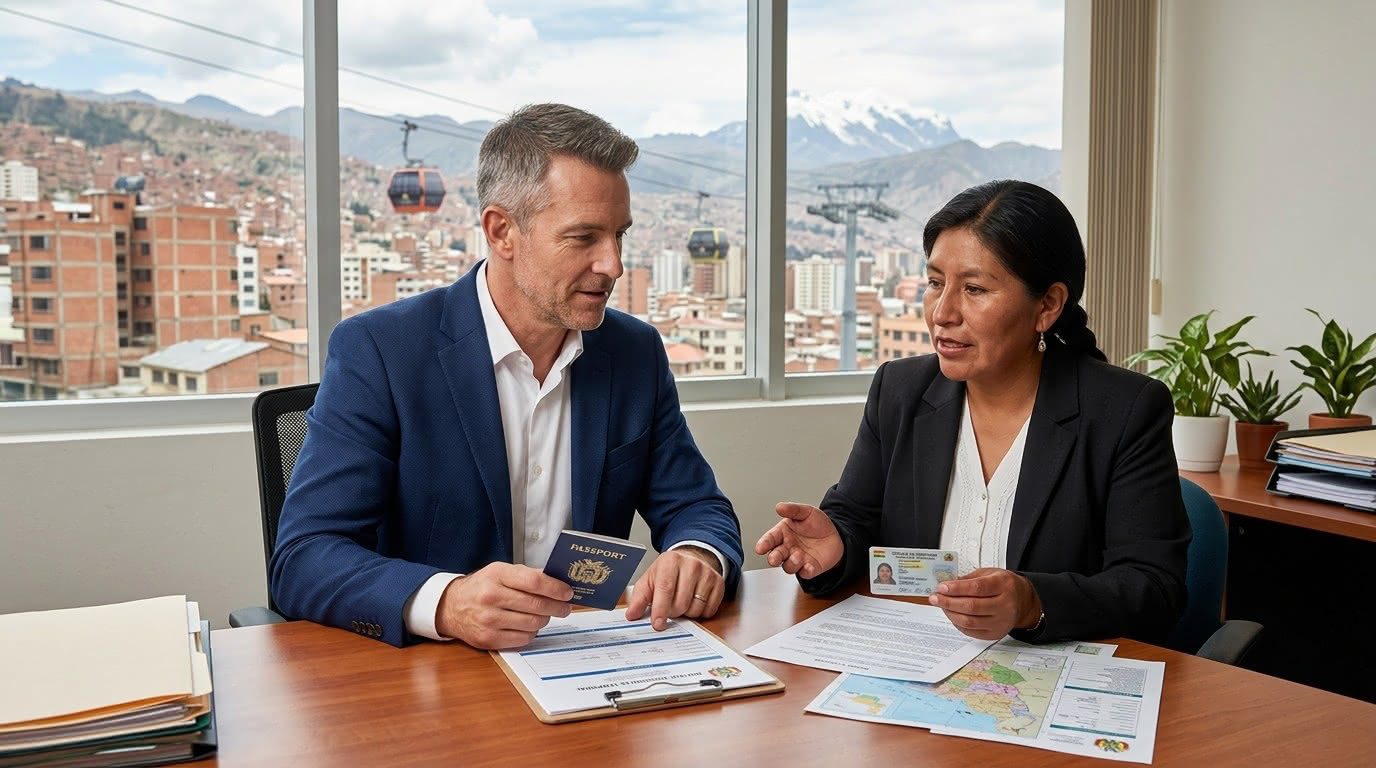
Bolivia appeals to this group because the country combines a straightforward residency ladder with low entry friction. A foreigner can start with a 1-year temporary visa using a passport, bank statements, a notarized sworn statement, a local medical certificate, Interpol records obtained in Bolivia, and a local address. A person who wants more continuity can form an SRL, sign a services contract, and go straight to a 3-year temporary visa.
Bolivia does not force a large paper trail for the initial stage, which allows you to receive a cédula, formally the Cédula de Identidad de Extranjero, or CIE. With that card, you can open bank accounts, access crypto exchanges used locally, serve as legal representative of a company, get a Bolivian driver’s license after passing the driving test, and operate in daily life anywhere in the diverse beautiful country of Bolivia.
Just keep in mind that Bolivian temporary residency does require real presence. You cannot spend most of the year elsewhere and expect the status to carry you to permanent residency. Bolivia allows a maximum of 90 days outside per year during temporary residency, extendable to 180 with prior written authorization, but you still need about 185 days of physical presence per year. Anyone building a multi-country setup around Bolivia needs to design around that rule from day one.
Where Bolivian residency fits in a global diversification plan
Bolivia works best as a complementary residency for people who want a Latin American base with a light initial immigration burden and territorial taxation. It fits several common profiles:
- People with foreign-source income, including investors, retirees, remote workers, and crypto holders.
- People who want a residency next to Paraguay for risk diversification.
- People who want a base without crypto wallet reporting.
- People who value a low-cost route to a resident ID and legal presence.
That does not mean Bolivia suits everyone. It is a poor fit for someone who cannot spend the majority of the year in Bolivia during temporary residency. It is also a poor fit for someone who expects banking infrastructure comparable to Europe or the United States. Bolivia has capital controls and dollar scarcity. If your strategy depends on advanced international banking, large institutional rails, or broad credit access, Bolivia should sit beside stronger banking jurisdictions, not replace them.
The residency ladder gives you two practical paths. Route A starts with the 1-year visa and suits people who want to test the country before forming a company. Route B starts with a services contract from a Bolivian company and leads straight to a 3-year temporary visa. The second route often makes sense for someone who already knows Bolivia will be part of a long-term plan and wants to avoid a year-one renewal. You can read the full process details in Bolivia residency in 2026: complete step‑by‑step guide.
For asset protection planning, the key point is continuity. Bolivia reviews your full SIGEMIG records, passport stamps, and movimiento migratorio when you apply for permanent residency after 3 continuous years. Gaps, mismatches, or undocumented absences can lead to denial. If temporary residency is cancelled, the 3-year clock resets. A serious diversification plan needs compliance, not improvisation.
Territorial tax, low cost of living and legal stability: key levers
Bolivia’s strongest strategic lever is territorial taxation. Bolivia taxes income generated within Bolivia. Bolivia does not tax foreign-source income such as investment returns, crypto gains, foreign rental income, pensions, or remote work for foreign clients. For many internationally mobile people, that changes the economics of residency.
A second lever is the cost and speed of obtaining status. In La Paz, people who arrange a local lawyer themselves often pay about $700 in legal fees, about $400 in government and administrative fees, and Bs 600 for the CIE, for a total of about $1,100 to $1,200 per person. Santa Cruz often costs more and takes longer. In practice, many people find that DIY with local counsel ends up costing more than PlanBolivia.com’s fixed, all-in residency offer once coordination, timing mistakes, and repeat visits enter the picture. If you want a bundled option, See pricing and packages.
The process speed also matters. After any mandatory 15-day window for Groups 2 and 3, the visa filing can move fast. The medical certificate takes about 3 days, Interpol records run in parallel, the visa can be issued the same day you file in La Paz or Santa Cruz when queues allow, and the CIE at SEGIP finishes the process (cards print in La Paz; Santa Cruz typically waits for the shipped card). That gives Bolivia a role that many slower jurisdictions cannot fill, a fast path to legal resident status.
Legal stability matters too. Bolivia applies the Impuesto a las Grandes Fortunas (IGF) wealth tax for high-net-worth individuals above a statutory threshold; the administration has proposed repeal and submitted bills to Congress, but as of March 2026 repeal is not yet enacted and the IGF remains formally in force (early press often misreported the announcement as completed law). The current administration has also moved in a pro-market and pro-foreign-investment direction, and it shifted the United States and South Korea into the visa-free tourist group. No government direction stays fixed forever, but the present framework supports foreign investors more than the previous one.
For financial privacy and reporting, Bolivia currently has not implemented CRS or CARF. Bolivian banks do not automatically share account information with foreign tax authorities through CRS, and Bolivian crypto platforms are outside the OECD CARF network at present. If you want more detail on that, head over to read our dedicated article here CRS & CARF Status in Bolivia.

Combining Bolivia with EU, Caribbean or UAE options
Many people do not want one residency. They want a stack of options that serve different purposes. Bolivia can fit into that stack in a few practical ways.
-
Bolivia as the physically present base. A person spends the majority of the year in Bolivia during temporary residency, builds continuity toward permanent residency, and keeps other residencies for travel access, business convenience, or family planning.
-
Bolivia as the low-friction Latin American leg. A person with a more expensive or more formal residency elsewhere uses Bolivia as an additional foothold with territorial taxation and a relatively low setup burden.
-
Bolivia next to Paraguay. Bolivia functions surprisingly well as a complementary base for people coming from Paraguay who want risk diversification and no crypto wallet reporting. If you are comparing regional Plan B options, our article on Bolivia vs Paraguay vs Panama: which Plan B residency fits you? is a great read for you!
When you combine Bolivia with Europe, the Caribbean, or the UAE, the main planning issue is not theory and bureaucracy. It is simpler, it's the control of your calendar and agenda. Bolivia requires majority physical presence during temporary residency. That means you need to map travel windows, business trips, family visits, and any requested absence extension in advance.
Bolivia does offer an extension (prórroga) for up to 180 days total outside the country per year with prior written authorization and documented justification. You must request it before departure while you are still in Bolivia. Accepted justifications include medical treatment abroad, a business memo from your own company, or family emergency documentation. That tool helps, but it does not turn Bolivia into a paper residency.
If your wider setup depends on spending most of the year outside Bolivia, another structure may fit better, but if you can spend more than 185 days per year in Bolivia during the temporary residency period of 3 years, Bolivia can really anchor the Latin American side of your plan and become much more flexible after permanent residency, when absence allowances expand to up to 2 years cumulative outside the country. Bolivia isn't a bad place to spend 185 days a year!
Banking, companies and real estate: how to structure holdings
The cédula opens practical doors. You can open Bolivian bank accounts and act as legal representative of a company. For many of our clients, that alone gives Bolivia massive strategic value. It creates a local identity document and a compliant way to operate within the country, and for opening exchange (ej. Kraken, Binance) or brokerage accounts (ej. IBKR) abroad.
For company structures, the usual recommendation is an SRL, a Sociedad de Responsabilidad Limitada. The SRL requires a minimum of 2 partners, allows up to 25, and has minimum capital of Bs 200, about $20. Formation takes 1 to 2 weeks. Foreign partners can participate by power of attorney and do not need to be in Bolivia. The SRL also limits liability to your capital contribution. That matters because a unipersonal company exposes your personal assets to company losses and commitments.
People often use the SRL in one of two ways:
- They form it before applying for the 3-year visa and hire themselves through a services contract.
- They form it during the first year and use the services contract for renewal into years 2 and 3.
You need to keep the company real enough to withstand scrutiny. Authorities can investigate a company as simulated or fraudulent if it has zero actual presence, zero activity, poor tax compliance, or no address verification. The company does not need to be highly profitable, but it should not exist only on paper with no connection to Bolivia.
Foreign staffing rules also affect planning. Foreign employees can make up only 15% of the workforce, foreign payroll is capped at 15% of total payroll, and foreign hires must be technical or specialist staff. If you expect to run an operating business inside Bolivia with a foreign-heavy team, you need to structure carefully.
Real estate can play a role in a broader holding plan, but the knowledge base does not set out a property acquisition framework, financing rules, or title process. If you want to include Bolivian property in your structure, Get in touch and we can review your situation with you.
Risk management: political, tax and currency considerations
Any asset-protection plan fails if it relies on wishful thinking. Bolivia offers advantages, but you should build around the real risks.
- Presence risk. During temporary residency, excess absence can cancel your visa and reset your time toward permanent residency. The cancellation process itself is manageable, but the lost continuity is the main cost.
- Record-mismatch risk. Bolivia checks SIGEMIG records, passport stamps, and movimiento migratorio. Unofficial crossings and undocumented exits can create a permanent problem in your file.
- Banking risk. Bolivia has capital controls and dollar scarcity. Use Bolivia as part of a broader banking plan, not as your only banking jurisdiction.
- Domestic tax risk. Bolivia does not tax foreign-source income, but income generated inside Bolivia falls into the domestic system. If you plan to earn significant income inside Bolivia, you need to model that before moving operations.
- Policy-change risk. Bolivia has not implemented CRS or CARF today, but the country joined the OECD Global Forum. Future changes remain possible, and any long-term structure should account for that.
Political direction matters as well. The current administration has taken a pro-market line, cut spending, restored US relations, and signaled support for foreign investment, and has submitted bills to Congress to repeal several taxes including the IGF (wealth tax). As of March 2026 that repeal is not yet enacted and the IGF remains formally in force. That improves the near-term case for Bolivia. A prudent investor still treats any residency jurisdiction as one component of a diversified legal map.
Currency planning takes a bit of discipline too. Bolivia maintains an official exchange rate of Bs 6.96 per dollar, while actual paralel market conditions can differ over time. Anyone living on foreign income should review current conditions before arrival and plan liquidity conservatively.
Example strategies for HNWIs, entrepreneurs and retirees
Different profiles use Bolivia in different ways. These examples show where the fit is strong and where it is weak.
1. The high-net-worth investor with offshore income.
The investor holds foreign
securities, earns portfolio income abroad, and wants a second residency with territorial taxation and low
reporting friction. Bolivia can work if the investor wants to spend the majority of the year there during
temporary residency. The 3-year route through an SRL often suits this profile because it removes the year-one
renewal and creates a direct runway to permanent residency.
2. The crypto-heavy entrepreneur.
The entrepreneur wants a Latin American base with no
wallet reporting requirement, no personal tax ID for foreign income, and access to local and global exchanges
used in Bolivia. Bolivia fits as a complementary base, especially for someone already considering Paraguay
diversification. The crypto-entrepreneur should pair Bolivia with stronger foreign banking jurisdictions and
maintain careful compliance on physical presence.
3. The remote founder who wants a test year.
The founder enters as a tourist, waits 15
days, and applies for the 1-year visa using bank statements or proof of monthly income, a sworn statement, a
local medical certificate, Interpol records, and a local address. This route keeps upfront commitment lower,
get to know the beautiful and diverse country of Bolivia as well as neighboring countries such as Paraguay. If
the first year works out nicely in Bolivia, the founder can form an SRL and renew with a services contract,
and a common add on is to also start the process in Paraguay as an add-on residency for diversification.
4. The retiree with pension income.
A retiree with foreign pension income can use
Bolivia’s territorial tax framework and low entry burden, retirees often value stability, low cost of living,
and ease of residency over citizenship. Permanent residency is often the practical endpoint because it allows
indefinite stay rights and up to 2 years cumulative absence outside Bolivia. The person should still plan
carefully around the temporary-residency presence rules for the first 3 years.
5. The family planner.
The families primary applicant secures residency first, then
brings a parent or other qualifying family member through a dependent visa or an independent application. For
a parent-based dependent visa, Bolivia requires the primary applicant’s birth certificate with apostille to
prove the relationship, along with the same financial solvency requirements and the dependent’s passport.
Families who need help with sequencing can review Moving your family to Bolivia:
what parents need to know.
The common thread in all of these strategies is discipline. Bolivia can serve as a surprisingly useful home-base or as a second base, as an efficient tax residence, a quick resident ID platform, or a long-term permanent residence play. It does not work well as a paper status for someone who plans to live elsewhere most of the year during the initial temporary visa period of 3 years.
Want to map your next step? Read Why Wealthy Expats Put Bolivia on Their Plan B List or Bolivia vs Paraguay vs Panama: Which Plan B Wins?, then get in touch when you're ready. You can also see pricing and packages.
Frequently Asked Questions
How does Bolivian residency fit into a global diversification strategy?
Bolivia works best as a complementary base for people who want territorial taxation, a straightforward residency path, and a second legal foothold in Latin America. It is often a fit for investors, retirees, remote workers, and crypto holders with foreign-source income.
Does Bolivia tax foreign income if I become a resident?
No. Bolivia uses a territorial tax system, so only income generated within Bolivia is taxed. Foreign-source income such as investment returns, crypto gains, pensions, foreign rental income, and remote work for foreign clients is not taxed in Bolivia.
Can I keep Bolivian residency if I spend most of the year outside the country?
Not during temporary residency. You can be outside Bolivia for up to 90 days per year, or up to 180 days with prior written authorization, but you still need about 185 days of physical presence per year to maintain continuity toward permanent residency.
Do I need a Bolivian company to get residency?
No for the first year. You can apply for the 1-year temporary visa with a sworn statement, bank statements, medical certificate, Interpol records, passport, and local address. A Bolivian company becomes useful if you want a 3-year visa from the start or need to renew beyond year one.
How much does Bolivian residency usually cost if I arrange it locally?
In La Paz, people who arrange a local lawyer themselves often pay about $1,100 to $1,200 per person including legal, government, and cédula fees. If you want a fixed all-in option, check the pricing section on planbolivia.com or get in touch through the PlanBolivia.com website.