By Frank G. & Edwin H.
Bolivia residency in 2026: 7 steps to your CIE

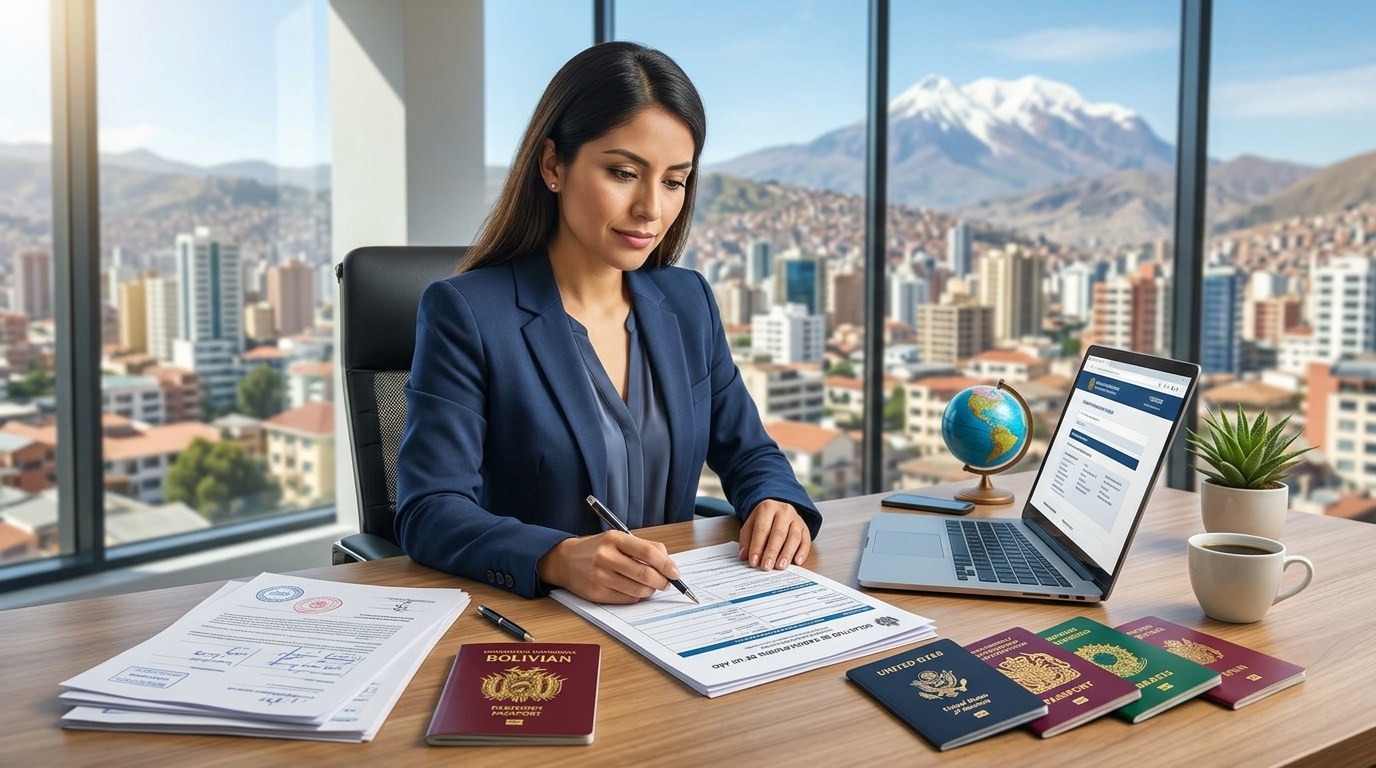
You can land in Bolivia with a passport and apply for residency once local documents are ready, most Western passport holders (Group 1) have no mandatory 15-day tourist wait before filing; Groups 2 and 3 must complete 15 days first, without bringing an apostilled birth certificate or a home-country criminal record. Most people who want the lightest address package process in La Paz, where a hosted stay with door-and-host details often suffices; Santa Cruz asks for a written agreement identifying the property owner, a recent electricity bill, and a copy of the owner's ID, Airbnb still works there with that documentation. That surprises many people because most Latin American residency systems ask for far more paperwork at the start.
Bolivia offers a clear path from tourist entry to temporary residency, then permanent residency, then citizenship. If you plan the timing well and protect your continuity, you can move through the system with fewer documents than many applicants expect.
This guide covers the practical steps, the main residency routes, the timelines people see in La Paz, and the costs you should expect.

Why consider Bolivia for residency in 2026
Bolivia suits a specific type of applicant.
- People with foreign-source income, such as investors, remote workers, retirees, and crypto holders
- People who want a faster residency process with fewer initial document requirements
- People who value territorial taxation, where Bolivia taxes income generated inside Bolivia, not foreign-source income
- People who want a second base next to Paraguay for diversification
Bolivia does not fit everyone. Temporary residents must respect a strict absence rule. If you need to stay outside the country for more than 6 months each year, Bolivia will create friction until you reach permanent residency. Banking infrastructure also differs from Europe or the United States, and the country has capital controls and dollar scarcity.
The core practical benefit is the CIE (cédula de identidad de extranjero), Bolivia’s foreign-resident ID card issued with your visa. Once you hold it, you can open Bolivian bank accounts, access exchanges used locally, serve as legal representative of a company, apply for a Bolivian driver’s license after passing a driving test, and handle daily contracts and administrative tasks inside Bolivia.
Overview: temporary, permanent residency and citizenship
Bolivia uses a ladder. You start with tourist entry, then move into temporary residency, then permanent residency, and later citizenship if you want it.
You have two main routes.
- Route A, 1-year temporary visa: enter as a tourist, complete local checks (Group 1: file when ready; Groups 2/3: after 15 days), apply with bank statements and a sworn statement, then renew into a longer status with a services contract or company for year 2 and beyond.
- Route B, 3-year temporary visa: enter as a tourist, complete local checks (same Group 1 vs 2/3 rule), apply with a services contract from a Bolivian company, and receive a 3-year temporary visa directly.
After 3 continuous years of temporary residency, you can apply for permanent residency. After 3 years of continuous permanent stay, you can apply for citizenship. Citizenship requires a Bolivian history test, an apostilled and translated birth certificate, your original visa documents, approval by the Foreign Relations Ministry, and about 1 year of processing time.
You need to treat continuity as the main rule. If immigration cancels your temporary visa, your 3-year clock resets to zero.
Step 1: decide if Bolivia fits your goals (tax, lifestyle, Plan B)
Start with your use case, not the paperwork.
If you earn abroad and want legal residency with a low-document process, Bolivia can work well. Bolivia uses a territorial tax system. It taxes income generated within Bolivia. It does not tax foreign-source income such as foreign investment returns, crypto gains, foreign rental income, pensions, or remote work for foreign clients.
If you need a backup base, Bolivia also offers a practical second residency with a path to a local ID card and local company setup. If you want to spend most of the year outside the country before permanent residency, review the absence rules with care.
- Temporary residency, maximum 90 days outside per year, extendable to 180 with prior authorization and proper justification
- Permanent residency, maximum 2 years outside, cumulative
- Citizenship, no absence restrictions after grant
People who know they want to stay and want the cleanest runway often choose the 3-year route through a Bolivian company and services contract. People who want to test Bolivia first often start with the 1-year route because it does not require company formation.

Step 2: prepare documents in your home country
For the initial temporary residency stage, Bolivia asks for far less from your home country than many applicants expect.
For the 1-year temporary visa, you need:
- A valid passport, original and photocopy
- Bank statements showing either at least $5,000 in your account or monthly income above about $400
You do not need a birth certificate for the 1-year visa. You do not need a home-country criminal record for the 1-year visa. Bolivia replaces that document with an Interpol check completed inside Bolivia.
The roughly $5,000 threshold aligns with about 12–13 months at Bolivia’s minimum-salary benchmark (~$400/month); immigration expects that level of solvency on statements. If your income varies from month to month, a lump sum in the account can work better than trying to prove recurring income.
If you plan to bring a dependent on a family visa, gather the relationship document that proves the link. For example, if your mother applies as your dependent, immigration needs your birth certificate to prove the relationship. If you plan to apply for citizenship years later, you will need an apostilled and translated birth certificate at that stage, not for the initial 1-year visa.
If you want the 3-year route from the start, you also need a services contract from a Bolivian company. That company can be your own SRL, but foreign companies do not qualify for this purpose.
Step 3: obtain the Specific Purpose Visa (Objeto Determinado)
The process described here starts from tourist entry and change of status inside Bolivia. The practical route most applicants use is to enter Bolivia as a tourist, complete local medical and police checks, and then apply to change immigration status once eligible (Group 1: no 15-day wait; Groups 2/3: from day 16).
Tourist entry rules depend on nationality. EU citizens, US citizens, South Korean citizens, and Mercosur nationals can enter visa-free under the categories described for 2026. The tourist allowance listed for those groups is 90 days per calendar year, not per entry. Border runs do not reset the count.
If your nationality falls outside those groups, you should check current Bolivian consular classification before travel.
The key planning point is timing. Group 2 and Group 3 nationals must spend 15 full days in Bolivia before filing (day 16 onward). Group 1 nationals can begin filing as soon as local documents are ready. Most applicants still use their first days in Bolivia to settle housing, organize bank statements, start local checks, and coordinate with a lawyer.
Step 4: enter Bolivia and file your residency application
Once you arrive, the process becomes concrete.
- Enter Bolivia as a tourist.
- If Group 2/3: wait 15 full days in country before filing; if Group 1: proceed as soon as documents are ready.
- Early in your stay, secure a local address, prepare your bank statements, and engage a lawyer so medical and Interpol steps can run in parallel.
- Complete the medical certificate in Bolivia. This takes about 3 days and includes a doctor examination and samples.
- Complete the Interpol records process in Bolivia.
- Sign the notarized sworn statement declaring your intent to develop an activity in Bolivia. A lawyer prepares the text.
- File your application with immigration once your nationality’s waiting rule (if any) and local checks are complete.
For the 1-year temporary visa, the sworn statement replaces the need for a company at the start. You state that you intend to develop economic activity in Bolivia, such as opening a business, starting a company, or exploring opportunities.
The address requirement depends on where you file. In La Paz, practice is usually light: a photo of the front door, plus the owner’s full name, DNI number, and phone number. An Airbnb host’s details are enough; you do not need a formal lease for the typical initial filing. In Santa Cruz, requirements are slightly heavier but still light: a written agreement (notarized or simple) identifying the property owner, a recent electricity bill, and a copy of the owner's ID card. A full formal lease is no longer required for the typical filing, and Airbnb stays work with that documentation. The main reason many applicants still process in La Paz is faster CIE completion, SEGIP prints cards there, so pickup is often same-day; Santa Cruz usually waits for the card to ship from La Paz. If you move after filing, update your address in the immigration system.
For the 3-year route, you file the same general residency package plus a services contract from a Bolivian company. Many applicants use an SRL for this. An SRL needs 2 partners, allows up to 25, has minimum capital of Bs 200, and usually takes 1 to 2 weeks to form. The legal representative must already hold a cédula, so people often coordinate the order of steps with counsel.
Step 5: visa in passport and CIE (resident ID) at SEGIP
DIGEMIG can issue the temporary-residency visa on the day of filing, often within about one to two hours, in La Paz or Santa Cruz. The process is not complete until you finish the CIE at SEGIP, the physical resident ID. Cards are printed in La Paz: pickup is often same-day there; in Santa Cruz expect roughly two to three extra weeks for the printed card after your appointment, plus scheduling.
The CIE is the practical finish line for most new residents. It lets you:
- Open Bolivian bank accounts
- Use exchanges used locally
- Serve as legal representative of a company
- Apply for a Bolivian driver’s license after passing a driving test
- Sign contracts and function day to day as a resident
If you entered on the 1-year path, mark your calendar early. Start the renewal process about 3 months before your visa expires. The 1-year sworn statement option is not available for renewal, confirmed by both partner firms. For year 2 and beyond you need one of the following: a services contract from a Bolivian company (typically your own SRL), a labor contract with a Bolivian employer, NIT registration as an independent or remote business with invoicing in Bolivia, or a family-based renewal if you are a dependent tied to the main holder's status. A tax declaration plus a Bolivian bank account showing foreign-income deposits may also work, though this option is still being formally confirmed with immigration. Renewal now requires the full document set every time (medical exam, Interpol, police, narcotics, bank statements, address), so plan that window in country.
If you plan to operate through a company, lawyers in Bolivia often recommend an SRL over a unipersonal company. The SRL limits liability to your investment. A unipersonal structure can expose your personal assets to business losses and commitments.
How long it really takes (with realistic timelines)
People often mix up the tourist waiting period and the processing period. Keep them separate.
- Mandatory waiting period before filing: 15 days inside Bolivia as a tourist, Groups 2 and 3 only; Group 1 has no such rule
- Medical certificate: about 3 days, completed in Bolivia
- After filing at DIGEMIG: visa often same day in La Paz or Santa Cruz; CIE at SEGIP completes the process, cards print in La Paz (often same-day pickup there; Santa Cruz typically ~2–3 weeks for the physical card after your appointment)
- Santa Cruz note: same-day visa issuance as in La Paz; longer end-to-end timeline is usually the CIE physical card shipping from La Paz (~2–3 weeks after SEGIP appointment, plus scheduling), not visa speed
- SRL formation: 1 to 2 weeks
- Citizenship processing: about 1 year once filed
If you choose Route A and you are Group 1, you can often file soon after local checks and finish the visa quickly; adding the CIE in La Paz is typically the fastest path because cards are printed there. If you choose Route B and need to form an SRL first, you need to add company setup time.
La Paz often stays the fastest path for the full visa-plus-CIE loop in 2026 because SEGIP prints cards there. Many applicants process there even if they plan to live in Santa Cruz later, because legal fees can be lower and address paperwork is sometimes simpler, visa speed itself is no longer meaningfully different by city.
Typical costs and hidden fees to expect
If you arrange a local lawyer yourself, the common cost range for a 1-year residency case in La Paz is about $1,100 to $1,200 per person. That estimate includes about $700 in legal fees, about $400 in government and administrative fees, and a cédula fee of Bs 600. In Santa Cruz, people often pay about $1,400 to $1,500 per person, with higher legal fees and a longer process.
You should also budget for the decisions that change the route:
- SRL formation if you want the 3-year visa from the start
- Renewal costs after year 1 if you start on the 1-year path
- Cancellation and restart costs if you break the absence rule during temporary residency
The absence rule creates one of the most expensive mistakes. If you stay outside Bolivia for more than 90 days in the calendar year without an approved extension, immigration can treat your visa as lapsed when you re-enter. In this scenario, there is no automatic fine or blacklist. You then enter as a tourist, complete a cancellation process, pay roughly $1,050 in legal fees for cancellation and a new visa application (about $350 cancellation plus $700 for the new visa), pay government fees again, and lose your accumulated time toward permanent residency and citizenship.
DIY applicants also miss smaller practical costs. You may need extra nights in La Paz if a document takes longer than expected. You may lose time if you arrive without the local address details immigration wants. You may also choose the 1-year route to save money at the start, then pay more in aggregate once you include renewal and extra travel.
Many people find that DIY ends up costing more than PlanBolivia.com’s bundled offer because the local lawyer, government fees, follow-up time, and avoidable mistakes add up. PlanBolivia.com offers a fixed all-in price for the residency process, with current details on the site, See pricing and packages.
When to DIY and when to hire a residency expert
DIY can make sense if you speak Spanish well, can stay in Bolivia long enough to handle timing issues, and do not mind coordinating the medical certificate, Interpol process, notary visit, immigration filing, and cédula appointment yourself.
Most applicants benefit from local help because the process moves through several offices in a short period. In La Paz, the assigned lawyer often accompanies the client to each step except the medical examination. The client appears in person, while the lawyer handles paperwork, payments, and office coordination.
You should consider professional help in any of these situations:
- You want the 3-year route and need to coordinate an SRL and services contract
- You plan to bring dependents and want to avoid document mistakes
- You need to manage absence risk because you travel often
- You want to process in La Paz, get the cédula fast, and leave with the least downtime
Bolivia gives you a short document list, but the process still depends on timing and continuity. The biggest wins come from filing on schedule, choosing the right route from the start, and protecting your status once you have it.
Want to map your next step? Read Bolivia Residency Documents: Nationality Checklist or Temporary vs Permanent Bolivia Residency: Pick Right, then get in touch when you're ready. You can also see pricing and packages.
Frequently Asked Questions
Do I need apostilled documents from my home country to start residency in Bolivia?
No. For the initial 1-year temporary residency, Bolivia does not require an apostilled birth certificate or a home-country criminal record. You apply with your passport, bank statements, a sworn statement, and local checks completed in Bolivia.
How long does the Bolivia residency process take in 2026?
Timing depends on nationality group and local document speed. Most Western passport holders (Group 1) can file at DIGEMIG as soon as medical, Interpol, address, and bank paperwork are ready. Groups 2 and 3 must spend 15 full days in Bolivia before filing from day 16 onward. The visa is often issued the same day in La Paz and Santa Cruz; the CIE at SEGIP finishes the process, with cards printed in La Paz (often same-day pickup there, roughly two to three weeks extra delay for the physical card in Santa Cruz after your appointment).
Can I get a 3-year Bolivian residency visa right away?
Yes, if you apply with a services contract from a Bolivian company. Many applicants use an SRL for this route, which can take 1 to 2 weeks to form.
How much money do I need to qualify for the 1-year residency visa?
You need bank statements showing at least $5,000 in your account or monthly income above about $400. That amount reflects roughly a year at Bolivia’s minimum-salary benchmark used for solvency checks.
What happens if I stay outside Bolivia too long during temporary residency?
If you exceed the 90-day absence limit without approved authorization, immigration can treat your visa as lapsed when you re-enter. There is no automatic fine or blacklist in this scenario. You can restart the process, but your residency timeline resets to day 1 and you must pay fees again.