By Frank G. & Edwin H.
Why wealthy expats put Bolivia on their Plan B list

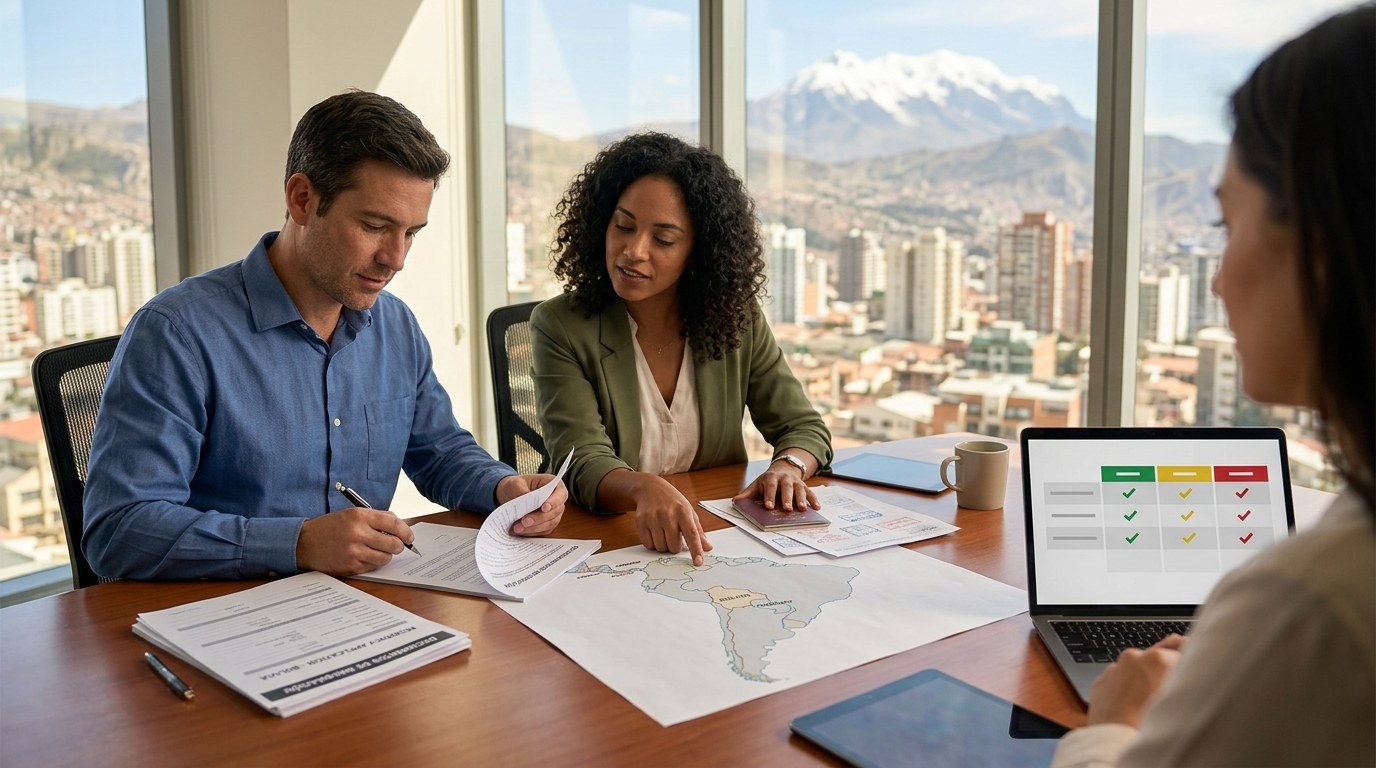
A founder sells a company, moves part of his liquidity into crypto and foreign brokerage accounts, and starts asking a new question. He does not need one perfect country. He needs options. He wants a place where he can get legal status without months of paperwork, where foreign income stays outside the local tax net, and where a second base does not force him into a large investment program. Bolivia has started to enter that conversation.
For many affluent expats, a Plan B no longer means a vacation home. It means a second residency, a national ID card, a local company if needed, and a base that fits into a broader multi-country setup. Bolivia appeals to that group for one reason above all: the system remains unusually direct. A foreigner can enter as a tourist, complete local checks, and often receive the visa the same day after filing at DIGEMIG in La Paz or Santa Cruz, Group 1 has no mandatory 15-day tourist wait; Groups 2 and 3 do, with the CIE at SEGIP finishing the loop (cards print in La Paz). That speed changes how people evaluate the country.
That does not make Bolivia the right fit for everyone. A wealthy person who needs top-tier banking infrastructure, constant international wire flexibility, or long periods outside the country during temporary residency should weigh those limits with care. But for investors, retirees, remote earners, and crypto holders who want another flag, Bolivia has features that deserve a serious look.
If you want the full mechanics of the residency process itself, read Bolivia residency in 2026: complete step‑by‑step guide.

Global trends: why HNWIs are collecting residencies and passports
High-net-worth families often build redundancy into banking, custody, citizenship, schooling, and health access. Residency now sits in the same category. A second residency can give a family a lawful place to live, bank, sign contracts, run a company, and spend time while they keep their primary business and assets elsewhere.
Bolivia fits that pattern because the country offers a clear ladder from tourist entry to temporary residency, then permanent residency, then citizenship. A person can start with a 1-year temporary visa based on a sworn statement and bank statements, or move straight to a 3-year temporary visa if a Bolivian company provides a services contract. After 3 continuous years, the person can apply for permanent residency. After 3 years, the person can pursue citizenship, which includes a history exam and Foreign Ministry approval, with about one year of processing.
That sequence matters to wealthy expats because it reduces uncertainty. You can test the country with a lower-commitment route, or you can commit early and remove the year-one renewal step.
- The 1-year route does not require a company, a birth certificate, or a home-country criminal record for the initial residency.
- The 3-year route lets a committed applicant skip the year-one renewal if a Bolivian company, including the applicant’s own SRL, issues a services contract.
- The cédula gives the holder practical local capacity, including bank account access, exchange access used locally, company representation, and driver’s license eligibility after a driving test.
Wealthy people often value optionality more than prestige. Bolivia does not market itself as a polished global wealth hub. It offers something else, a residency system that many people can complete with far less friction than they expect in Latin America.
The tradeoff sits in the absence rules. During temporary residency, the holder gets 90 days outside Bolivia per calendar year by default and can apply for an extension of up to another 90 days (180 total per calendar year) before the first 90 expire, approval is not automatic and depends on the justification provided. A family that wants a true “set and forget” status from day one needs to understand that limit before applying.
What makes Bolivia interesting for high‑net‑worth individuals
The strongest draw for affluent foreigners is the combination of fast residency, low documentary burden, and territorial taxation. Bolivia taxes income generated inside Bolivia. The country does not tax foreign-source income such as foreign investment returns, crypto gains, pensions, foreign rental income, or remote work for foreign clients.
That matters for a person whose economic life sits abroad. A retiree with a pension, an investor living off portfolio withdrawals, or a founder with offshore income does not need a local tax structure for those foreign earnings. The person can obtain residency and a cédula without entering a system built around taxing global income.
Bolivia also keeps the first step light. For the 1-year temporary residency, the applicant needs:
- A valid passport
- Bank statements showing at least $5,000 in the account, or monthly income above about $400
- A notarized sworn statement declaring intent to develop an activity in Bolivia
- A medical certificate obtained in Bolivia
- Interpol records obtained in Bolivia
- A local address (La Paz): front-door photo, owner name, DNI number, and phone number (often via Airbnb). Santa Cruz: a written agreement identifying the property owner, a recent electricity bill, and a copy of the owner's ID, Airbnb still works with that documentation.
In La Paz, an Airbnb can work for the address; the person can update the address later in the immigration system. Santa Cruz now requires only slightly more paperwork (written agreement, electricity bill, owner ID), but a full formal lease or Folio Real is no longer required and Airbnb stays still work.
Bolivia also gives direct value through the cédula. Once the applicant has the ID card, he or she can:
- Open Bolivian bank accounts
- Access crypto exchanges used locally, including Meru and Binance
- Serve as legal representative of a company
- Apply for a Bolivian driver’s license after passing a driving test
- Sign contracts and operate in ordinary daily life with local identification
The wider political direction has also drawn attention. President Rodrigo Paz took office in November 2025. His administration has a supermajority in congress and has moved toward spending cuts, restored US relations, and approval of Starlink, and has submitted bills to Congress to repeal several taxes including the IGF (wealth tax). As of March 2026 that repeal is not yet enacted and the IGF remains formally in force. The government also moved US and South Korean nationals into Group 1 for visa-free tourist entry. For many HNWIs, those signals matter because they suggest an opening phase rather than a tightening phase.
People also notice Bolivia’s current position outside the main automatic reporting architecture. Bolivia has not implemented CRS or CARF as of March 2026. Bolivian banks do not currently share account information with foreign tax authorities automatically. Bolivia recently joined the OECD Global Forum, so this could change later, but there is no current implementation timeline.
Cost vs benefit compared to more famous "golden visa" programs
Many wealthy expats first look at residency-by-investment programs because those programs get the most coverage. Bolivia appeals to a different buyer. It does not ask for a large passive investment to start the residency process. It asks for proof of solvency, local records obtained in Bolivia, and the patience to spend the required days in country.
The first-year route illustrates the contrast. A person can qualify with $5,000 in the account at the time of application, or monthly income above about $400. Group 1 can often complete the active filing window in about a week once local documents are ready; Groups 2 and 3 add 15 days in country before filing. The visa is often issued the same day in La Paz and Santa Cruz when queues allow; the CIE at SEGIP finishes the process, with cards printed in La Paz (often same-day pickup there, roughly two to three weeks extra delay for the physical card in Santa Cruz after your appointment). That creates a very different experience from programs that involve months of document prep, apostilles, consular certifications, and offshore fund movement.
Where legal fees run highest in Santa Cruz, with a slower timeline than La Paz, people who hire a local lawyer on their own often end up around $1,400 to $1,500 per person once you add legal fees, government and administrative charges, and the cédula fee (Bs 600). La Paz is usually lower for the same loose DIY stack, often nearer $1,100 to $1,200. Those figures are local lawyer plus government costs only; they do not include coordinated relocation support or English-language advisory.
PlanBolivia.com’s Standard package is $1,999 per person for 1-year residency, with lawyer fees and government fees included. For about what the expensive end of the DIY market already costs, you get end-to-end handling and a fixed price. Multi-Year is $2,499 per person for up to 3 years of residency via our optimized-for-you pathway. Both packages are available in La Paz or Santa Cruz. Add-ons: VIP Fast-Track (+$499) and Mastermind community (+$50/mo). See full pricing.
For affluent applicants, the larger question is not whether Bolivia is expensive. It is whether Bolivia offers enough utility without the capital lock-up that famous investor visas require. In many cases, the answer is yes.
- You can establish legal presence without tying up a large property purchase or fund subscription.
- You can move from tourist to resident with a short, defined document list.
- You can reach permanent residency after 3 continuous years.
- You can pursue citizenship after 3 years, with dual citizenship allowed.
The main costs do not come from state investment thresholds. They come from time in country, basic legal support, and, if you choose the 3-year route, forming a Bolivian company. An SRL needs minimum capital of Bs 200, around $20 at the blue rate, plus legal fees, and formation takes 1 to 2 weeks.
DIY applicants should also count the cost of mistakes. A missed absence limit can cancel the temporary visa and reset the 3-year clock toward permanent residency and citizenship. A weak setup for renewal can create delays around month 12. A local lawyer reduces those risks, and many people find that DIY ends up costing more in time and repeat fees than a fixed bundled service, especially when the out-of-pocket lawyer-and-government total is already in the same band as a coordinated package.

Banking, company structures, and real‑estate angles for HNWIs
Affluent expats rarely need residency for immigration alone. They want local functionality. In Bolivia, the cédula is the key asset because it unlocks ordinary economic life. Once you hold it, you can open bank accounts, act as legal representative of a company, and use local exchanges that residents use.
You should still approach banking with clear expectations. Bolivia does not offer banking infrastructure comparable to Europe or the United States. The country has capital controls and dollar scarcity. A wealthy person who needs complex cross-border banking, broad private banking products, or high-volume dollar movement should treat Bolivia as one piece of a larger structure, not as the sole hub.
For company setup, the common structure is the SRL, Sociedad de Responsabilidad Limitada. Lawyers recommend it over a unipersonal company because the SRL limits liability to the invested capital. A unipersonal company leaves the owner personally liable for losses and commitments.
The SRL has a few important features for HNWIs:
- It requires at least 2 partners and allows up to 25.
- It needs minimum capital of Bs 200.
- It takes 1 to 2 weeks to form.
- Foreign partners can participate by power of attorney and do not need to be in Bolivia.
- The legal representative must have a cédula.
- If clean, with no employees, debts, or tax activity, it can often be closed in 1 to 2 weeks.
That structure creates a practical route for a wealthy applicant who wants the 3-year visa from day one. The person forms an SRL with a spouse, parent, partner, or co-founder as the second shareholder, then uses a services contract from that Bolivian company to apply for the 3-year temporary residency. The company does not need to be profitable or active at a large scale for this purpose. It needs to exist and contract with the applicant.
Domestic income brings different rules. Bolivia taxes income generated inside the country, and a company may employ foreigners in at most 15% of positions, with 85% required to be Bolivian. A wealthy family that plans to earn substantial local business income should get local legal and tax guidance before building an operating company.
The knowledge base does not set out a formal real-estate residency track, so readers should not assume that property purchase gives immigration benefits. Some affluent foreigners will still look at housing for personal use or local presence, but the residency process itself does not depend on buying real estate. For the address requirement in La Paz, a hosted apartment can be enough; Santa Cruz typically needs lease, utilities, and Folio Real.
Privacy, security and lifestyle considerations at higher wealth levels
Privacy often sits high on the list for wealthy expats. Bolivia attracts attention here for two reasons. First, the country has not implemented CRS or CARF as of March 2026. Second, Bolivia does not require a personal tax ID for a resident who lives on foreign-source income and does not run a domestic revenue business. A resident can obtain the cédula and open a bank account without entering a broad local reporting structure for foreign earnings.
No prudent person should treat that as a permanent condition. Bolivia joined the OECD Global Forum, which signals movement toward international tax transparency. People who value privacy should read Bolivia as a country with current advantages, not fixed guarantees.
Crypto-minded expats also see an opening. Bolivia’s crypto regulation remains early. The country has no wallet reporting requirement, no specific crypto capital gains tax for individuals, and no established enforcement framework described in the source material. Bolivia signed an MOU with El Salvador’s CNAD to develop the regulatory framework, and the Bolivian government has used stablecoins for fuel import transactions. Local legal contacts also report wide office-level use of USDT.
Lifestyle cuts both ways for high-net-worth residents. La Paz offers the fastest known processing, with one-week timelines and centralized steps downtown, and lighter address documentation than Santa Cruz, but the altitude reaches 3,640 meters. Many people can handle that for a short processing stay, then move on to Santa Cruz after obtaining the cédula. Santa Cruz offers a different lifestyle profile, though the documented processing there is slower, more expensive, and heavier on property paperwork for the address file.
The blue dollar rate also changes daily life. Bolivia’s official rate stands at Bs 6.96 per dollar, while the parallel market has traded around Bs 9.00 to 9.50. For someone earning in dollars or crypto, that gap can create strong local purchasing power. That benefit does not remove the banking and dollar-liquidity issues, but it does affect living costs and local spending.
Security-conscious families should also focus on compliance with absence rules. During temporary residency, the 90-day outside limit matters more than many people expect. If immigration cancels the visa after an excessive absence, the person can restart, but the continuity clock resets. A person with a company can apply in advance for an extension up to 180 days outside Bolivia with proper justification, such as a business memo, medical certificate, or family emergency documents. That tool can make Bolivia more workable for mobile HNWIs.
How wealthy families structure their presence in Bolivia
Affluent families often choose between three broad setups, depending on commitment, travel habits, and whether they want a company from the start.
The first setup is the low-commitment test year. One spouse or principal applicant enters as a tourist, waits out any mandatory 15-day window for Groups 2 and 3 (Group 1 can file as soon as local documents are ready), then applies for the 1-year temporary residency using the sworn statement and solvency documents. This route works well for people with variable investment income because the bank statement can show the $5,000 lump sum instead of fixed monthly salary. The family often uses a hosted stay in La Paz with door-and-host details for the address (or lines up Santa Cruz’s lease-and-title package if filing there), then uses the first year to decide whether to renew through a company route.
The second setup is the direct 3-year path. A committed applicant forms an SRL, hires himself or herself under a services contract, and applies for the 3-year temporary visa after the same Group 1 vs 2/3 timing rule for filing. This route removes the month-12 renewal step and creates a clean runway toward permanent residency. Families who know they want Bolivia in the long-term structure often prefer this option.
The third setup is the dependent or parallel-family route. Bolivia allows dependent visas based on the main resident’s status. For a parent dependent, the applicant needs the principal’s birth certificate to prove the relationship, plus the same solvency requirement and the dependent’s passport. In some families, independent applications also make sense. A family member can apply separately through the same year-one process if that person has enough income. The source material notes that a pension of €600 per month exceeds the minimum threshold.
These structures often look like this in practice:
- A principal applicant secures the CIE first, opens local accounts, and forms an SRL later if the family wants the 3-year route or renewal support.
- A parent joins as a dependent, with the relationship proved through the principal applicant’s birth certificate.
- A spouse or partner becomes the second SRL shareholder to satisfy the partner requirement.
- A mobile business owner uses the company to support an advance-approved absence extension up to 180 days when travel demands it.
The family should also keep the endgame in mind. Permanent residency arrives after 3 years of continuous temporary residency and carries a far lighter absence rule, up to 2 years cumulative outside Bolivia. Citizenship removes absence restrictions and allows dual nationality, but it requires an apostilled and translated birth certificate, the original visa documents, a Bolivian history test, Foreign Ministry approval, and about one year of processing.
That full timeline will not suit a person who wants a passport in months. It can suit a family that wants a practical residency now, local functionality soon, and a longer-term citizenship option later.
Want to map your next step? Read Bolivia Plan B Residency: Who It Fits Best or Bolivia vs Paraguay vs Panama: Which Plan B Wins?, then get in touch when you're ready. You can also see pricing and packages.
Frequently Asked Questions
Why are wealthy expats considering Bolivia as a Plan B?
Many affluent expats want a second residency that is fast to obtain, does not require a large investment program, and fits into a multi-country setup. Bolivia stands out for its straightforward residency process, territorial taxation, and the practical value of the cédula for banking, contracts, and company use.
Do I need to invest in property or put large capital into Bolivia to get residency?
No. The initial 1-year residency route does not require a property purchase or large investment. Applicants typically qualify with a passport, local records obtained in Bolivia, a sworn statement, and proof of financial solvency such as $5,000 in an account or monthly income above about $400.
Can a wealthy expat go straight to a longer Bolivian visa?
Yes. A person can apply for a 3-year temporary visa if a Bolivian company provides a services contract, including the applicant's own SRL. That route suits people who already know they want a longer-term base and want to avoid the year-one renewal.
How does Bolivia tax foreign income for residents?
Bolivia uses a territorial tax system. Income generated outside Bolivia, including foreign investment returns, crypto gains, pensions, foreign rental income, and remote work for foreign clients, is not taxed locally.
What is the main limitation wealthy expats should understand before using Bolivia as a Plan B?
The main operational limit is the absence rule during temporary residency. A resident gets 90 days outside Bolivia per calendar year by default and can apply for an extension of up to another 90 days (180 total per calendar year) before the first 90 expire, but approval is not automatic and depends on the justification provided.