By Frank G. & Edwin H.
Bolivia vs Paraguay vs Panama: which Plan B wins?

You want a second residency, but you do not want to build your life around paperwork. You want a place where you can qualify without dragging apostilled documents across three consulates, or locking up a large amount of capital before you know whether the country fits.
That is where the comparison usually starts to get fuzzy. People group Bolivia, Paraguay, and Panama into the same “Plan B” bucket, but they solve different problems. Bolivia stands out for one reason: the entry process is unusually light. For initial residency, Bolivia does not require an apostilled birth certificate, a home-country criminal record, or company formation if you start with the 1-year route.
If you are weighing options, the useful question is not which country sounds best online. The useful question is what kind of residency model matches your income, travel pattern, and tolerance for bureaucracy.
For a full Bolivia walkthrough, see Bolivia residency in 2026: complete step‑by‑step guide.

Quick overview of each country’s residency model
Bolivia offers a clear ladder from tourist entry to temporary residency, then permanent residency, then citizenship. You can enter as a tourist, then apply once eligible: Group 1 files when documents are ready; Groups 2 and 3 after 15 days in country.
- Route A, 1-year visa: no company required. You apply with a sworn statement, bank statements, medical certificate, Interpol records, passport, and a local address.
- Route B, 3-year visa: you need a services contract from a Bolivian company. That company can be your own SRL.
That gives Bolivia two distinct profiles. The first profile wants low commitment and wants to test the country for a year. The second profile knows he or she wants continuity to permanent residency and is willing to form a local company.
Paraguay and Panama attract the same broad audience, people seeking a backup base, tax efficiency, or a second residency, but they often come up in a different role inside a wider international setup. Bolivia often fits as the cleaner, lighter entry point for people who value speed, few documents, and foreign-income treatment with no tax on income earned outside Bolivia.
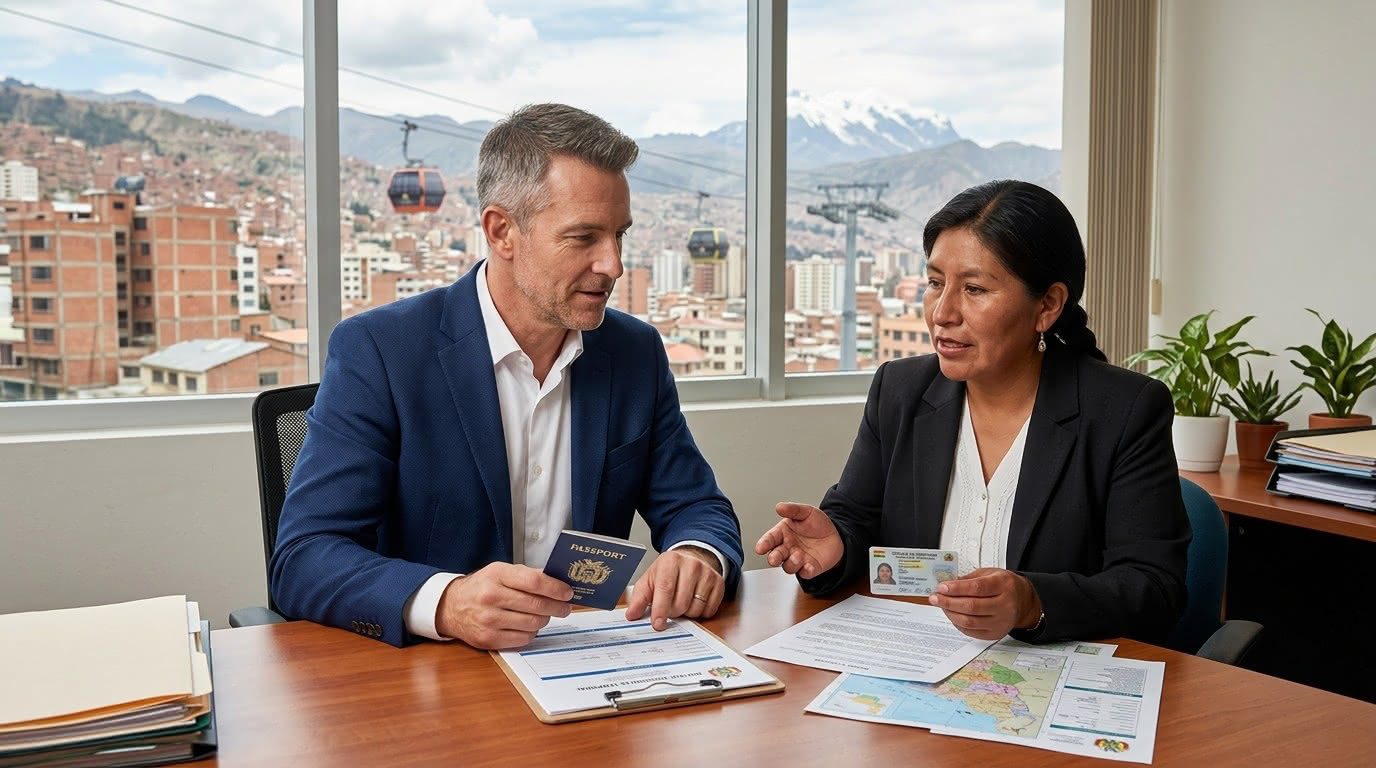
If you care about what you receive at the end of the process, Bolivia’s core deliverable is the cédula de ciudadanía, the national ID card. With that card, you can open Bolivian bank accounts, access crypto exchanges used locally, serve as legal representative of a company, apply for a Bolivian driver’s license, and handle contracts and daily administration inside the country.
That practical endpoint matters more than many people expect. A residency approval with no usable local ID often feels abstract. The cédula gives Bolivia immediate day-to-day utility.
Cost of entry: minimum investment or proof of funds
Bolivia keeps the financial threshold low for the 1-year residency route. You do not need to open a company in year one. You do not need to show a large investment. You need to show one of the following:
- $5,000 or more in your account at the time of application, or
- monthly income above about $400, based on the minimum salary at the official rate.
That structure suits several groups:
- investors with uneven income
- remote workers with foreign clients
- retirees with a pension
- crypto holders who can show funds in an account
Bolivia’s 3-year route raises the commitment level, not through a stated large capital threshold, but through local structuring. You need a services contract from a Bolivian company. If you form your own SRL, the minimum capital is Bs 200, about $20 at the blue rate, plus legal formation costs. The SRL takes 1 to 2 weeks to form and needs at least 2 partners.
People who arrange the process with a local lawyer often pay about $1,100 to $1,200 per person in La Paz for the 1-year process, or about $1,400 to $1,500 in Santa Cruz. In La Paz, that estimate includes about $700 in legal fees, about $400 in government and administrative fees, and Bs 600 for the cédula. Costs for the 3-year route rise because company formation adds another layer.
DIY applicants often assume they will save money. In practice, DIY often ends up costing more than a fixed bundled service once you factor in delays, repeat visits, and local coordination. PlanBolivia.com offers a fixed all-in price for the residency process. See pricing and packages.
For Paraguay and Panama, many people focus on capital thresholds, bank relationships, or formal investment structures. If you want to minimize upfront financial commitment and paperwork, Bolivia sits in a separate category.
Timelines to residency, permanent residency and citizenship
Bolivia gives you a fast initial result if you plan the first weeks correctly.
- You enter Bolivia as a tourist (or the entry category your passport requires).
- If you are Group 2 or 3, you stay in country for 15 full days before you may file to change status; Group 1 can file as soon as medical, Interpol, address, and bank paperwork are ready.
- Early in your stay, you secure a local address, prepare bank statements, and run medical and Interpol steps (often in parallel).
- When eligible, you file at DIGEMIG.
- Immigration often issues the visa the same day in La Paz or Santa Cruz, when queues allow.
- You complete the CIE at SEGIP, cards are printed in La Paz, so pickup is often fastest there; Santa Cruz typically adds roughly two to three weeks for the physical card after your appointment.
Many Group 1 applicants finish active steps in about a week once documents are ready; Groups 2 and 3 add the mandatory 15-day wait before filing. The visa is now issued the same day in both cities when queues allow; the longer Santa Cruz story is usually the shipped CIE from La Paz, not visa speed.
Bolivia also gives you a straightforward residency ladder:
- 1-year temporary residency if you start with the sworn statement route
- 2-year extension after year one, if you have a services contract or company
- Permanent residency after 3 continuous years
- Citizenship after 3 years, with a Bolivian history test, Foreign Ministry approval, and about 1 year of processing
If you start with the 3-year visa route, you skip the year-1 renewal and move straight toward permanent residency after 3 continuous years.
The main pitfall is absence. During temporary residency, you get 90 days outside Bolivia per calendar year by default. You can apply for an extension of up to another 90 days (180 total) before the first 90 expire, but approval depends on the justification you provide. If immigration cancels your temporary visa, your 3-year clock resets to zero. That reset causes more damage than the roughly $1,050 restart cost.
Once you reach permanent residency, Bolivia relaxes the absence rule. You can stay outside for up to 2 years cumulative. Once you hold citizenship, Bolivia imposes no absence restriction.
That continuity issue shapes the whole comparison. Some people need a residency they can keep while spending most of the year elsewhere. Bolivia can work for them only if they can respect the temporary-residency absence rule or secure authorized extensions.

Tax systems: territorial vs worldwide and practical impact
Bolivia taxes income generated inside Bolivia. Bolivia does not tax foreign-source income. That includes foreign investment returns, crypto gains, foreign rental income, pensions, and remote work income from foreign clients.
For many people looking at Bolivia vs Paraguay vs Panama: which Plan B residency fits you?, this is the section that decides the shortlist. A residency only helps if the tax treatment matches your income source.
Bolivia also does not require a personal tax ID for someone living on foreign-source income alone. You can hold a cédula and open a bank account without obtaining a RUC, unless you run a business inside Bolivia that generates domestic revenue.
Bolivia also has two financial features that many internationally minded residents notice:
- Bolivia has not implemented CRS or CARF as of March 2026.
- Bolivia does not currently require wallet reporting, and no specific crypto capital gains tax for individuals appears in the current framework described by local counsel.
That does not mean the country will stay frozen. Bolivia joined the OECD Global Forum, which signals movement toward more international transparency over time. No timeline for CRS implementation appears at present.
If you earn abroad, hold crypto, or invest internationally, Bolivia gives you a territorial system with a low-document residency process. If you plan to earn significant income inside Bolivia, the picture changes. Bolivia applies a 25% corporate tax on domestic income, and companies face a 50% foreign employee cap with 85% of the workforce required to be Bolivian.
Panama and Paraguay enter many international tax conversations for the same broad reason, but your practical outcome depends on details outside the scope of this article. For Bolivia, the known facts are clear: foreign-source income is not taxed, and the current reporting framework remains limited.
Lifestyle and infrastructure differences for expats
Residency structure matters, but daily life usually decides whether you stay.
Bolivia offers speed and administrative simplicity, but it comes with tradeoffs. The country does not offer banking infrastructure comparable to Europe or the United States. It has capital controls and periodic dollar scarcity. If your life depends on seamless banking, large international transfers, or deep financial rails, you need to weigh that carefully.
Bolivia does give dollar earners and crypto earners a local purchasing-power advantage because of the gap between the official exchange rate and the blue market rate. The official rate is Bs 6.96 per dollar, while the parallel market has traded around Bs 9.00 to 9.50, fluctuating daily.
Location also changes the experience. La Paz offers the fastest reported processing and centralized administration, but the altitude reaches 3,640 meters. Some applicants tolerate a week there and then move on to Santa Cruz after obtaining the cédula. Address proof is also lighter in La Paz than in Santa Cruz: our reported practice is that La Paz filings can use host-and-door details (including Airbnb), while Santa Cruz asks for a written agreement identifying the property owner, a recent electricity bill, and a copy of the owner's ID. Airbnb stays still work in Santa Cruz with that documentation, a full formal lease or Folio Real is no longer required for the typical filing.
Daily-life practicality in Bolivia includes:
- in La Paz, an Airbnb-style local address often works for the application; Santa Cruz needs slightly more documentation (written agreement, electricity bill, owner's ID) but Airbnb still works
- you can update your address later in the immigration system
- you can apply for a Bolivian driver’s license after you obtain your cédula and pass a driving test
- you can open bank accounts and access exchanges used locally
Bolivia also appeals to people who want a complementary base next to Paraguay, especially those focused on risk diversification and crypto privacy. That use case appears often among multi-flag planners.
Panama often enters the conversation when someone wants stronger infrastructure. Paraguay often enters the conversation when someone wants a regional base. Bolivia enters when someone wants a lighter immigration process and a territorial setup without broad foreign-income taxation.
Which profiles fit best with Bolivia, Paraguay, or Panama
Bolivia fits a specific type of applicant well. It does not fit everyone.
Bolivia fits best if you:
- earn income outside Bolivia
- want a fast and light initial process
- do not want to gather apostilled birth certificates or home-country criminal records for initial residency
- want the option to start with a 1-year trial before committing to a company
- value a territorial tax system and current lack of CRS implementation
- want a complementary second base alongside Paraguay
Bolivia fits poorly if you:
- need to stay outside the country for more than 6 months a year during temporary residency
- need banking infrastructure close to the US or Europe
- plan to build a business focused on significant domestic Bolivian revenue from the start
The absence rule is the dividing line for many applicants. If you can spend enough time in Bolivia to preserve continuity, or if you can support an authorized extension with proper documents, Bolivia remains attractive. If you need a residency card with minimal physical presence during the temporary stage, you should confirm other options country by country before you commit.
Paraguay and Panama often appeal to readers who prioritize other factors first, such as infrastructure, banking, or a different style of regional base. Bolivia appeals to readers who prioritize document simplicity, low proof-of-funds thresholds, and direct access to a usable local ID.
Example scenarios: HNWI, crypto founder, young family, digital nomad
1. High-net-worth investor with foreign income
You live from investments, dividends, foreign rentals, or portfolio gains. You do not need local Bolivian income. You want a clean residency with limited paperwork and an ID card you can use in-country. Bolivia works well if you can respect the temporary absence rule. The 1-year route gives you a low-commitment start, and the 3-year route works if you want continuity and are willing to form an SRL.
2. Crypto founder or crypto-heavy resident
You hold crypto, use stablecoins, and care about reporting exposure. Bolivia offers territorial taxation for foreign-source income, no CRS implementation as of March 2026, no wallet reporting requirement, and a crypto framework that remains early-stage. Local use of exchanges such as Meru and Binance adds practical utility after you obtain the cédula. This profile often sees Bolivia as a strong complement to Paraguay rather than a replacement for it.
3. Young family or parent-child relocation
You want a residency path that can bring family members in without a pile of civil documents at the start. Bolivia can work well here. Dependents can apply on the basis of the main holder’s residency. For a parent, the key relationship document is your birth certificate, not the dependent’s. A family member can also apply independently through the same 1-year route if he or she meets the financial solvency requirement.
4. Digital nomad with foreign clients
You invoice clients abroad and want a legal base with low friction. Bolivia’s tax treatment suits foreign client income, and the initial document load stays light. The question is travel rhythm. If you spend long stretches outside the country, Bolivia can become awkward during temporary residency. If you can stay within the 90-day absence rule, or qualify in advance for an extension up to 180 days with proper justification, Bolivia remains a workable option.
5. Founder testing the country before building anything
You do not want to form a company on day one. Bolivia gives you that choice. Start with the 1-year visa through the sworn statement route. If the country fits, form an SRL later and use a services contract for renewal. If you already know you want the long path to permanent residency, the 3-year route removes the year-1 renewal step.
Each of these profiles asks a different question. The investor asks about taxes and continuity. The crypto founder asks about reporting and exchange access. The family asks about dependency documents. The nomad asks about absence limits. The founder asks how much commitment to make upfront.
Want to map your next step? Read Bolivia Plan B Residency: Who It Fits Best or Why Wealthy Expats Put Bolivia on Their Plan B List, then get in touch when you're ready. You can also see pricing and packages.
Frequently Asked Questions
What makes Bolivia different from Paraguay or Panama for a Plan B residency?
Bolivia stands out for its light initial document load and fast process. For the first-year residency route, Bolivia does not require an apostilled birth certificate, a home-country criminal record, or company formation.
How much money do I need to qualify for Bolivia residency?
For Bolivia’s 1-year temporary residency, you need to show either at least $5,000 in your account or monthly income above about $400. People who hire a local lawyer often spend about $1,100 to $1,200 per person in La Paz for the first-year process.
How fast can I get residency in Bolivia?
Timing depends on nationality group and local document speed. Most Western passport holders (Group 1) can file at DIGEMIG as soon as medical, Interpol, address, and bank paperwork are ready. Groups 2 and 3 must spend 15 full days in Bolivia before filing from day 16 onward. The visa is often issued the same day in La Paz and Santa Cruz; the CIE at SEGIP finishes the process, with cards printed in La Paz (often same-day pickup there, roughly two to three weeks extra delay for the physical card in Santa Cruz after your appointment).
Is foreign income taxed in Bolivia if I become a resident?
Bolivia uses a territorial tax system. Only income generated inside Bolivia is taxed, while foreign-source income such as remote work income, pensions, investment returns, rental income, and crypto gains is not taxed.
Can I keep Bolivia residency if I travel often?
During temporary residency, Bolivia gives you 90 days outside per calendar year by default. You can apply for an extension of up to another 90 days (180 total) before the first 90 expire, approval depends on the justification provided. If your temporary visa is cancelled for excess absence, your clock toward permanent residency resets.