By Frank G. & Edwin H.
Is Bolivia crypto-friendly? laws, banks & risks

A crypto investor lands in La Paz with USDT, foreign income, and one goal: get legal residency without dragging apostilled files across three countries. Bolivia stands out because the immigration side is light, the tax system is territorial, and crypto regulation remains early. That combination draws remote workers, investors, retirees, and people who want a second base next to Paraguay.
That does not make Bolivia frictionless. You still deal with dollar scarcity, capital controls, uneven banking infrastructure, and residency rules that can reset your timeline if you spend too long abroad. If you are asking, Is Bolivia crypto‑friendly? Laws, reality and risks, the practical answer is yes in some important ways, and cautious in others.
For many people, the appeal comes from a short list of facts:
- Bolivia taxes domestic income, not foreign-source income.
- Bolivia has not implemented CRS or CARF as of March 2026.
- There is no wallet reporting requirement.
- Residents can use their cédula to open bank accounts and access exchanges used locally.
- The immigration process can move fast in La Paz or Santa Cruz once you are eligible to file (Group 1: no 15-day tourist wait; Groups 2/3: after day 15).
If you want the residency process handled as a fixed, all-in service, PlanBolivia.com bundles the moving parts and current pricing is on the site. DIY cases often end up costing more once people add lawyer coordination, repeat visits, and mistakes. See pricing and packages.
If you want the residency mechanics first, read Bolivia residency in 2026: complete step‑by‑step guide.

Current legal status of crypto in Bolivia (official vs on‑the‑ground)
Bolivia sits in an early-stage phase. The country has no wallet reporting requirement, no specific crypto capital gains tax for individuals, and no established enforcement framework for crypto. That gives residents room, but it also means you should not expect a polished rulebook.
The broader direction points toward adoption and regulation rather than prohibition. Bolivia signed a memorandum of understanding with El Salvador’s CNAD to develop its crypto regulatory framework. The Bolivian government has also used stablecoins for fuel import transactions. Those two points matter because they show crypto use at both policy and operational levels.
On the ground, local use looks more practical than ideological. People turn to stablecoins and exchange channels because Bolivia has faced dollar scarcity and a parallel exchange market. The legal system has not built a mature crypto code around that reality, but the market has already adapted.
For a resident with foreign income, Bolivia’s tax treatment shapes the crypto conversation more than any dedicated crypto statute. Bolivia uses territorial taxation. Only income generated within Bolivia is taxed. Foreign-source income, including crypto gains, investment returns, pensions, foreign rental income, and remote work for foreign clients, is not taxed.
That does not mean you should treat Bolivia as a place to ignore records. It means the country does not currently impose the kind of crypto-specific reporting many people expect elsewhere. Bolivia also has not implemented CRS or CARF as of March 2026, so local banks do not automatically share account information with foreign tax authorities, and local crypto platforms do not report into the OECD crypto network.
You should keep one caveat in mind. Bolivia recently joined the OECD Global Forum as its 172nd member. That signals movement toward more international tax transparency over time. No timeline for CRS implementation appears today, but future change remains possible.
Banking, exchanges and fiat on‑ramps available to residents
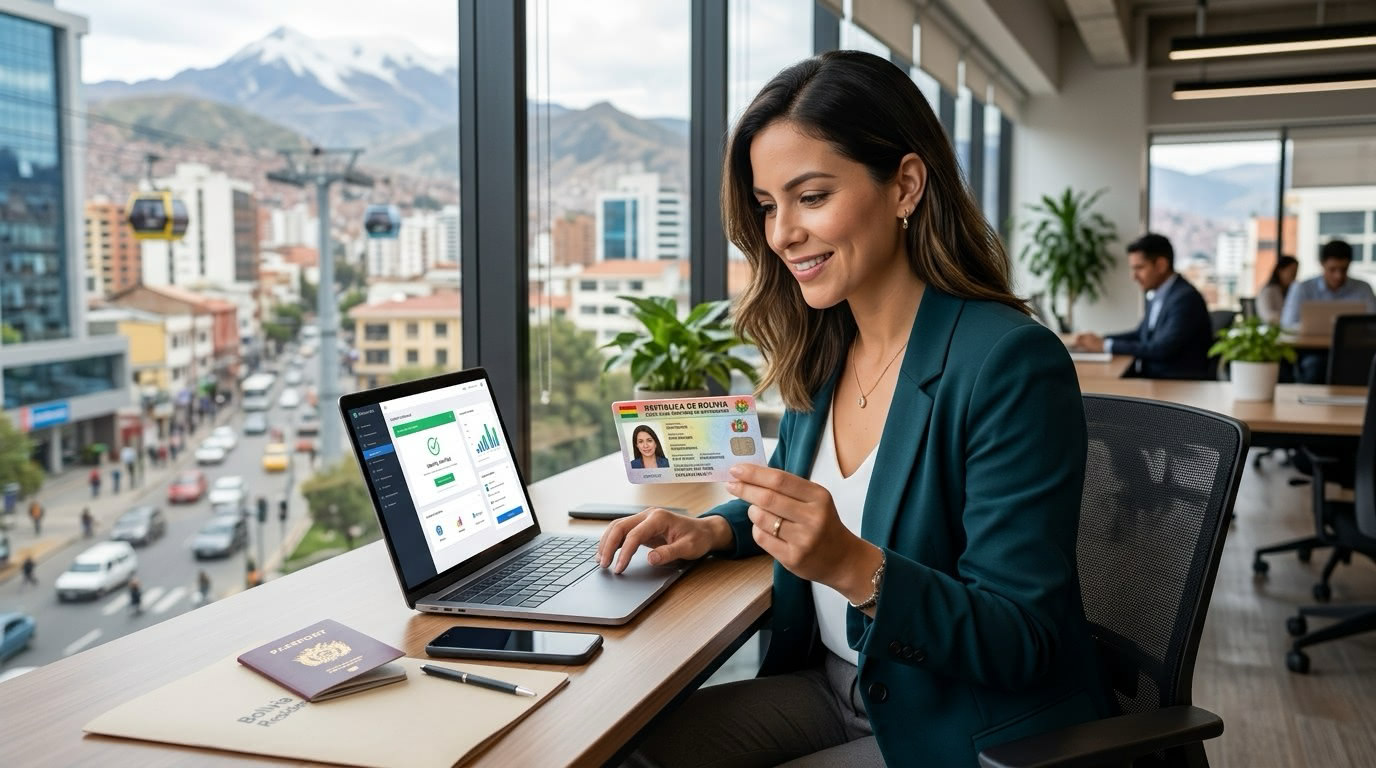
The most useful document for a crypto holder in Bolivia is not a wallet. It is the cédula de identidad de extranjero (CIE), the national ID card you receive through residency. Once you hold a cédula, you can open Bolivian bank accounts, access exchanges used locally, serve as legal representative of a company, get a driver’s license after passing the driving test, and handle day-to-day contracts.
That practical access matters more than abstract policy. A crypto-friendly country on paper helps less if a resident cannot move between crypto and local life. In Bolivia, people use Meru and Binance locally. For bank USDT custody, Banco Bisa runs the only live bank product (CriptoBisa). In November 2025 the Ministry of Economy authorized all banks to offer crypto-related services, but as of early 2026 Bisa remains the only bank operating that service.
Still, you need to separate access from convenience. Bolivia does not offer banking infrastructure comparable to Europe or the United States. The country has capital controls and dollar scarcity. You can open accounts with a cédula, but you should not expect deep dollar liquidity or a polished financial stack.
The exchange-rate environment also shapes behavior. Bolivia has an official exchange rate of Bs 6.96 per dollar and a parallel market rate of about Bs 9.00 to 9.50, with daily fluctuations. Under the new government, that gap improved from a previous peak around Bs 20 per dollar. For someone earning in dollars or crypto, the blue rate can increase local purchasing power.
That creates a pattern many foreigners follow:
- Keep income and savings outside Bolivia.
- Use residency and a cédula to operate legally inside the country.
- Convert funds into bolivianos when needed for living costs.
- Avoid dependence on local banking for global wealth storage.
If you plan to relocate, think of Bolivia as a place where residency, local spending power, and light reporting rules can fit together. Do not think of it as a replacement for a strong international banking base.
Practical risks for crypto founders and investors in Bolivia
The biggest risk for many crypto people in Bolivia is not a ban. It is residency continuity. Temporary residents get 90 days outside Bolivia per calendar year by default. You can apply for an extension of up to another 90 days (180 total per calendar year) before the first 90 expire, but approval is not automatic and depends on the justification you provide, such as a medical certificate, a business memo from your own company, or family emergency documents.
If you exceed the limit without approval, immigration can treat your visa as lapsed when you re-enter. You then enter as a tourist, complete a cancellation process, and apply again. There is no blacklist and no denial on that basis, but it costs roughly $1,050 in legal fees (about $350 for the cancellation plus $700 for the new visa application), government fees apply again, and your timeline resets. You lose your accumulated years toward permanent residency and citizenship. For globally mobile founders, that is a serious planning issue.
The second risk is financial infrastructure. Bolivia works well for legal presence and tax residence logic in some cases, but it does not work like Dubai, Singapore, or a top offshore banking center. Founders who need reliable dollar banking, broad payment rails, or institutional support should factor in the country’s limits.
The third risk is policy evolution. Bolivia has no wallet reporting requirement today and has not implemented CRS or CARF. That can change later. Anyone building a long-term plan around the current reporting gap should assume that the country may formalize its framework over time.
The fourth risk concerns domestic business activity. Bolivia taxes income generated inside the country. If you run a business that earns Bolivian-source revenue, the tax context changes. There is a 25% corporate tax on domestic income and a foreign employee cap, with 15% maximum foreign workforce and 85% Bolivian workforce. That makes Bolivia less attractive for a local operating company with a heavy foreign team.
For a founder, the practical risk list looks like this:
- You miss the 90-day rule and reset your residency clock.
- You rely on local banks for global operations and hit liquidity or control issues.
- You assume today’s crypto reporting gap will remain unchanged for years.
- You create domestic tax exposure through local business activity without understanding the difference between foreign-source and Bolivian-source income.
These risks do not cancel Bolivia’s appeal. They define the use case. Bolivia fits people who earn abroad, hold crypto or investments, and want a legal second base with light initial immigration requirements.

How crypto people actually use Bolivian residency today
Most crypto-oriented residents do not move to Bolivia to build a large domestic company. They use Bolivia as a personal base. The common profile includes remote workers, investors, retirees, and people who hold crypto or foreign assets. Bolivia works for them because the immigration process is direct and foreign-source income is not taxed.
The first route is the one-year temporary visa. You enter as a tourist, complete local checks, and apply when your nationality allows (Group 1: as soon as documents are ready; Groups 2/3: from day 16). For that first year, you do not need a company, a job contract, a birth certificate, or a home-country criminal record. You need a valid passport, bank statements showing at least $5,000 in the account or monthly income above about $400, a notarized sworn statement of intent to develop an activity in Bolivia, a medical certificate obtained in Bolivia, Interpol records obtained in Bolivia, and a local address.
That route works well for investors with variable income because the lump-sum bank balance can satisfy the solvency test. In La Paz, an Airbnb can work for the address requirement if the host gives you the door photo, name, DNI number, and phone number. In Santa Cruz, expect slightly more paperwork, a written agreement identifying the property owner, a recent electricity bill, and a copy of the owner's ID, but Airbnb still works there with that documentation, and a full formal lease or Folio Real is no longer required for the typical filing.
The second route is the three-year temporary visa. You still enter as a tourist and follow the same Group 1 vs 2/3 timing rule, but you apply with a services contract from a Bolivian company. That company can be your own SRL. This route skips the year-one renewal and gives you a continuous path to permanent residency after three years.
Crypto founders often prefer the three-year path if they know they will stay. The SRL structure supports that plan:
- An SRL requires two partners, with a maximum of 25.
- Minimum capital is Bs 200, about $20 at the blue rate.
- Formation takes 1 to 2 weeks.
- Foreign partners can participate by power of attorney and do not need to be in Bolivia.
- You can hire yourself through a services contract.
That company does not need to be profitable or highly active to support the services contract route. For many people, it functions as a residency tool more than a trading or operating vehicle.
La Paz usually offers the fastest processing. People who hire a local lawyer there often pay about $1400 in legal fees, around $400 in government and administrative fees, and Bs 600 for the cédula. That puts the common total around $1,900 to $2,200 per person for the one-year process when arranged with a local lawyer. In Santa Cruz, the legal fee tends to run higher and the process takes longer. Many people still choose La Paz for the paperwork, then move on after receiving the cédula.
The practical attraction is clear. A resident can secure legal status, obtain the national ID, open bank accounts, access exchanges used locally, and live in a country that does not tax foreign-source crypto gains under its territorial system.
Compliance, documentation and "don’t do this" examples
Bolivia gives residents flexibility, but you still need to follow the rules that exist. Most mistakes happen because people underestimate process details rather than because immigration blocks them on substance.
Keep these points in mind:
- If you are Group 2 or 3, wait 15 full days in Bolivia before applying to change immigration status. Group 1 can file as soon as local documents are ready, confirm your group before travel.
- Prepare your local address evidence early. In La Paz, use a front-door photo, owner’s name, DNI number, and phone number; in Santa Cruz, a written agreement identifying the property owner, a recent electricity bill, and a copy of the owner's ID, Airbnb still works.
- Start the renewal process about three months before a one-year visa expires if you plan to continue.
- Use the 180-day absence extension in advance if you need more time abroad.
- Keep your records organized even if Bolivia does not require wallet reporting.
Some bad decisions create avoidable problems.
-
A founder gets a one-year visa, spends four months abroad without requesting an extension, and returns expecting the visa to remain intact. Immigration can treat the status as lapsed. The person can restart, but the three-year clock toward permanent residency resets.
-
An investor assumes tourist border runs will preserve flexibility. Bolivia’s tourist limit is 90 days per calendar year for the listed visa-free nationalities, not 90 days per entry. Border runs do not reset that count.
-
A resident opens a local company without understanding labor limits for foreign staff. Bolivia caps foreign employees and expects a Bolivian-heavy workforce. That may not fit a founder who wants to import a full team.
-
A newcomer chooses a unipersonal company to save effort. The recommended structure is the SRL because it limits liability to your investment. A unipersonal company leaves you personally liable for losses and commitments.
Documentation for the first-year residency process stays light by regional standards. Bolivia does not require an apostilled birth certificate or home-country criminal record for the initial visa. It relies on local medical and Interpol checks. That simplicity helps, but it can also tempt people to improvise. Bring a valid passport, clean bank evidence, and a workable address setup for your filing city (lighter in La Paz than Santa Cruz), then follow the sequence.
If you overstayed as a tourist in the past and paid the fine at the time, the immediate record is cleared , but the overstay zeroes out the rest of your tourist day allowance for the year, so you cannot simply return as a tourist and apply. You would need to enter under a different visa category (such as a specific purpose visa) tied to your intended activity. Talk to us first if you have an overstay in your history so we can plan the right entry route.
Alternatives and complements: pairing Bolivia with other crypto hubs
Bolivia often works best as part of a broader structure rather than as a single-country answer for everything. It's always wise to have multiple flags, one common pairing with Bolivia is Paraguay. People coming from Paraguay use Bolivia as a complementary base with no crypto wallet reporting, and multi-flag planners use Bolivia as a residency and add Paraguay for diversification.
That pairing makes sense for a few reasons:
- Bolivia offers a simple residency route and a fast path to the cédula.
- Bolivia does not tax foreign-source income.
- Bolivia has no wallet reporting requirement today.
- Bolivia sits outside CRS and CARF for now.
- Paraguay residency serves as a second foothold in the region.
The tradeoff sits on the other side of the ledger. Bolivia does not give you top-tier banking infrastructure, and temporary residency imposes a strict presence rule unless you secure approved extra time abroad. People who need constant mobility or stronger banking often use Bolivia as one piece of the plan rather than the whole plan.
The current government’s direction supports that use case. The administration has moved toward economic reform, advanced bills in Congress to repeal several taxes, including the IGF (wealth tax); as of March 2026 that repeal is not yet enacted and the IGF remains formally in force. The administration has also restored US relations, approved Starlink, and eased tourist entry for countries such as the United States and South Korea by moving them into Group 1. The policy message is pro-market and pro-foreign investment. Local practitioners generally expect the direction on crypto to remain toward adoption and regulation.
That still leaves one final judgment call for you. Bolivia suits people who want legal residency, a national ID, territorial taxation, and a workable crypto environment with low initial friction. Bolivia does not suit people who need to stay out of the country for long stretches during temporary residency or who expect banking conditions similar to Europe or the United States.
Want to map your next step? Read Bolivia Foreign Income Tax: What Residents Keep or Bolivia CRS & CARF: What Foreign Residents Risk, then get in touch when you're ready. You can also see pricing and packages.
Frequently Asked Questions
Is Bolivia crypto-friendly for residents?
Bolivia is relatively crypto-friendly in practice because crypto regulation remains early, there is no wallet reporting requirement, and foreign-source crypto gains are not taxed under Bolivia’s territorial tax system. Residents still need to account for weak banking infrastructure, dollar scarcity, and future policy change.
Do Bolivian residents pay tax on foreign crypto gains?
Bolivia taxes income generated inside Bolivia. Foreign-source income, including crypto gains, investment returns, pensions, and remote work for foreign clients, is not taxed.
Can a resident in Bolivia use banks and crypto exchanges?
Yes. Once you have a cédula, Bolivia’s national ID card, you can open Bolivian bank accounts and access exchanges used locally, including Meru and Binance. Banco Bisa operates the only live bank USDT custody product (CriptoBisa); in November 2025 the Ministry of Economy authorized all banks to offer crypto-related services, but other banks have not yet launched comparable offerings.
What are the main risks for crypto investors or founders moving to Bolivia?
The main risks are residency continuity, limited banking infrastructure, and future regulatory change. Temporary residents can lose their status if they stay outside Bolivia for more than 90 consecutive days per year without approved extra time.
How much does it usually cost to get Bolivian residency with a local lawyer?
For the one-year residency process in La Paz, people who arrange a local lawyer themselves often pay about $1,100 to $1,200 per person including legal, government, and cédula fees. PlanBolivia.com offers a fixed bundled service, and current pricing appears in the pricing section on planbolivia.com.