By Frank G. & Edwin H.
Banking in Bolivia: open accounts with a CIE

Bolivia is in the middle of a currency revolution, and most expat guides have not caught up yet. Physical US dollars are leaving the banking system. Stablecoin transactions surged 530% in the first half of 2025. Toyota dealerships accept USDT. The state energy company is building a framework to pay for fuel imports in crypto. Two major banks now offer regulated USDT custody accounts. If you are moving to Bolivia with foreign income or crypto holdings, you are arriving at exactly the right moment.
This article walks through what banking actually looks like on the ground for a foreign resident: which banks to use, what you need to open an account, how to move money in and out, and how the stablecoin revolution changes the practical picture.
If you are still deciding whether residency fits your broader plan, read Is Bolivia a good Plan B residency in Latin America? and Bolivia residency in 2026: complete step-by-step guide.

The CIE is your key to everything
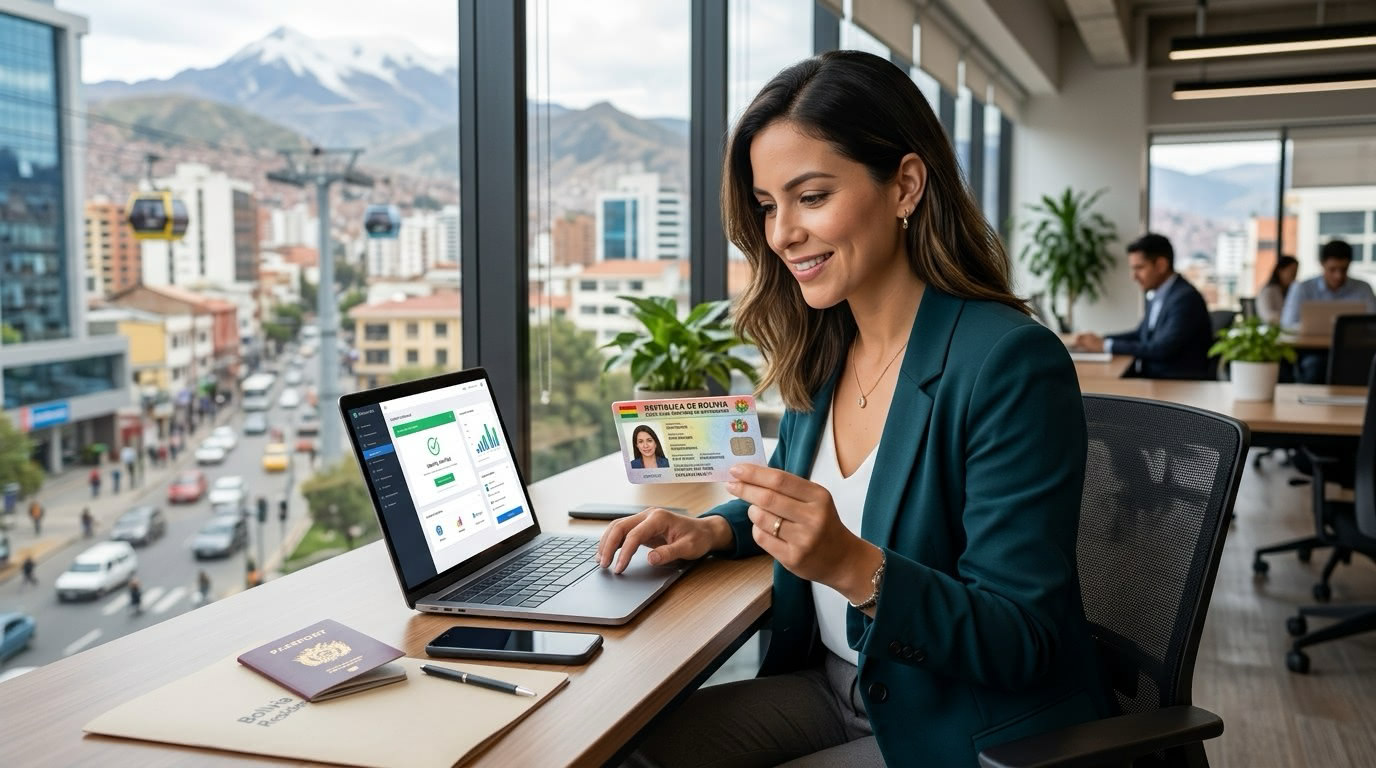
Banking in Bolivia starts with one document: the Cédula de Identidad de Extranjero (CIE), your foreign resident ID card issued by SEGIP. Without it, most banking activities are unavailable. With it, you can open checking and savings accounts in both bolivianos and US dollars, make international wire transfers via SWIFT, obtain loans, get Visa or MasterCard debit and credit cards, and send or receive money through Western Union and MoneyGram.
That makes the speed of your residency process directly relevant to your banking timeline. The visa is often issued the same day in La Paz and Santa Cruz when queues allow. The CIE is the variable leg: SEGIP prints cards in La Paz, so many applicants complete the physical ID fastest there; Santa Cruz typically adds roughly two to three weeks for the card to arrive after your SEGIP appointment, plus scheduling, not “higher demand” at the visa window. If getting a bank account fast matters to you, finishing SEGIP in La Paz is usually the faster route. For the full timeline, read Costs and timeline of getting residency in Bolivia.
Understanding Bolivia’s banking landscape
Bolivia has a handful of major banks that cover most of what a foreign resident needs. Here is how they compare:
Banco Mercantil Santa Cruz (BMSC) is the largest bank in Bolivia by assets, with 180 branches and 440 ATMs nationwide. It tends to have lower commissions than competitors and is strong for wire transfers and savings accounts. If you want a straightforward, reliable primary bank, BMSC is the safe default.
Banco Nacional de Bolivia (BNB) is the third largest and holds the best service quality rating in the country (CAMELS system). It is more oriented toward high-income clients and large companies, with 379 ATMs. Think of BNB as the premium option.
Banco Bisa is the crypto pioneer. It launched Bolivia’s first USDT custody service in October 2024 and remains the most recognized name in stablecoin banking. It has 339 ATMs, but its mobile app and digital platform are below average compared to competitors. You may want Bisa for crypto and a different bank for daily digital banking.
Banco de Crédito de Bolivia (BCP) has the best digital services in Bolivia, recognized by Global Finance in 2020. Its Soli app offers QR payments, account management, and money transfers. BCP is now also the second bank with live USDT accounts, where customers can buy USDT with bolivianos at a floating exchange rate and use USDT for international payments and remittances. For residents who want both good digital banking and stablecoin access, BCP may be the best single-bank option.
Banco Unión is the second largest but state-owned, focused on social lending and government services. Not typically the first choice for foreign residents.
All of these banks accept the CIE for account opening. Several maintain correspondent banking relationships with US banks, including BMSC, BNB, Bisa, BCP, Banco Económico, Banco Ganadero, and BancoSol, which means they can process international SWIFT transfers.
The dollar-to-USDT transition: what you need to know
Bolivia is going through a structural shift that directly affects how you should think about banking here. The short version: physical US dollars are scarce and getting scarcer. USDT is stepping in as the practical replacement.
Bolivia’s foreign exchange reserves collapsed from $12.7 billion in 2014 to roughly $171 million by August 2025. Traditional USD deposits now represent less than 14% of total bank deposits and the share keeps falling. Banks genuinely struggle to meet demand for physical dollars, which creates friction for international transfers and cash withdrawals in USD.
At the same time, stablecoin adoption has exploded. Crypto transaction volumes surged 530% in the first half of 2025. Bolivia processed nearly $15 billion in stablecoin transactions over the past year, ranking 46th worldwide for adoption. The central bank reported that crypto transactions through the formal banking system increased twelvefold between July 2024 and May 2025. Toyota, Yamaha, and BYD started accepting USDT for vehicle purchases in September 2025. The state energy company YPFB announced plans to use crypto for fuel imports. Businesses across the country have begun denominating prices in USDT.
The Economy Minister put it plainly: "You can’t control crypto globally, so you have to recognize it and use it to your advantage." In November 2025, the government authorized all banks to offer crypto custody, savings accounts, credit cards, and loans backed by digital assets. Stablecoins were declared to function as a legal tender payment instrument.
For a foreign resident arriving with crypto holdings or foreign-source income, this means the infrastructure you need is being built in real time. Banco Bisa and BCP already offer what you need. More banks will follow.

What you need to open an account
The core requirement is the CIE. Beyond that, banks will ask standard compliance questions: who you are, where your money comes from, what you plan to use the account for. The exact requirements vary by institution, but the foundation is always your resident ID.
Your residency application already establishes a financial profile. You showed bank statements with at least $5,000 or monthly income above approximately $400. You signed a sworn statement about your intended activity in Bolivia. Your bank account opening should be consistent with that profile. If you told immigration you are an investor, tell the bank the same thing. Consistency matters more than complexity.
One practical note: your local address can affect things at the residency stage. In La Paz, Airbnb host details work for the immigration process. In Santa Cruz, you need a written agreement identifying the property owner, plus a utility bill and the owner’s ID card. A full formal lease is not required, but you do need more documentation than La Paz.
Moving money in and out of Bolivia
This is where the exchange rate picture matters. Bolivia maintains an official exchange rate of Bs 6.96 per dollar, but the parallel market rate (widely called the dollar blue) sits around Bs 9.30. That gap means the method you use to move money makes a real difference to your purchasing power.
Here is how the main channels compare:
Binance P2P gives you approximately Bs 9.30 per dollar, about 34% better than the official rate. This is the best rate available but requires comfort with crypto and P2P trading.
WanderWallet offers QR payments at around Bs 9.05, roughly 30% better than official and now tracking the parallel market closely. No cash needed, works at merchants across Bolivia.
Remitly offers about Bs 8.13 per dollar, 17% better than official. This is a formal remittance service that deposits directly into Bolivian bank accounts. No crypto required. Good middle ground for people who want better-than-bank rates without touching crypto.
MoneyGram and Meru cash-outs land at roughly Bs 6.98, essentially the official rate. Not useful for exchange rate advantage.
Bank transfers and ATMs process at Bs 6.96, the official rate. The worst option for large amounts. Bolivia’s financial regulator does allow banks to charge international transfer fees partially linked to the parallel rate, so the effective cost may be slightly higher than the official rate suggests.
One important tax to know about: Bolivia charges a 2% Financial Transaction Tax (ITF) on all US dollar transfers leaving the country through the banking system. This applies to outbound international transfers, not internal ones. The ITF is one of four taxes President Paz has announced for repeal alongside the wealth tax, but as of early 2026 the repeal has not been enacted. Factor this into any plan to move USD out of Bolivia through banks.
For most foreign residents, the practical model is: convert USD or crypto to bolivianos via Binance P2P or Remitly at a favorable rate, keep bolivianos in your local bank account for daily spending, and use Banco Bisa or BCP for any USDT-related transactions.
Daily banking: QR, cash, and cards
Bolivia is still a cash-first country for day-to-day spending. Over 95% of transactions at shops, markets, and even malls are in cash. You should carry Bs 200 to 350 (roughly $30 to $50) for a normal day out.
That said, digital payments are growing fast. Bolivia was the first Latin American country to launch an interoperable QR payment system, called QR Simple, in 2019. It exploded during COVID lockdowns and now handles 91% of all interbank transfers. Every major bank participates.
Two apps worth knowing about: Soli by BCP Bank handles QR payments, account management, and money transfers. You need at least temporary residency to use it. Tigo Money is a phone-number-based payment system that lets you send and receive money, pay bills, and hold a balance. Both are widely accepted in urban areas.
International cards (Visa and MasterCard) work at major retailers and ATMs, but transactions typically process at the official exchange rate, which gives you the worst value. Use cards as a backup, not as your primary spending method.
Keeping your account in good standing
The most common banking problems for foreign residents do not start at the bank. They start when your immigration record, address history, and account activity stop matching each other.
Your CIE is the foundation of your banking relationship. Use the same identity and address details across your residency and banking records. Keep your source-of-funds story clean and consistent with what you told immigration. If you receive foreign dividends, say that. If you live on remote consulting income, say that. If you hold crypto, structure the conversation around documented sources and the specific institution’s products.
Protect your residency status. Temporary residents need about 185 days of physical presence per year in Bolivia. If you exceed the 90-day absence limit without prior authorization, immigration can treat your visa as lapsed on re-entry. Your CIE stays in your hands but the underlying visa becomes invalid, and that creates obvious problems for a banking relationship that depends on your resident status.
If you form a company as part of your residency strategy, make sure it has genuine business substance. Bolivian authorities can investigate simulated or fraudulent company arrangements, and banks also tend to scrutinize structures that lack a credible business purpose.
Bolivia reviews the full electronic immigration record (SIGEMIG), passport stamps, and migration history when you apply for permanent residency after three years. Gaps and mismatches create problems that can spill over into your banking life. Keep your records clean from the start.
Bolivia’s tax treatment and your bank account
Bolivia operates a territorial tax system. Foreign-source income is not taxed. There is no capital gains tax for individuals, no CRS or CARF reporting (banks do not share account information with foreign tax authorities), no wallet reporting, and no crypto capital gains tax for individuals. For the full tax picture, read Tax optimization opportunities and limits for high-net-worth residents in Bolivia and How Bolivia treats foreign income and tax residency.
If you need formal proof of Bolivian tax residency for a foreign authority, the CIE alone does not provide that. You must request a Tax Residency Certificate from SIN (Servicio de Impuestos Nacionales) separately.
Getting started
Banking in Bolivia works well once you understand the local realities. Use the CIE as your anchor. Pick your bank based on what you actually need: BMSC for reliability and low fees, BCP for digital quality and USDT access, Bisa for crypto pioneering, BNB for premium service. Convert your foreign currency at the best rate you can get (Binance P2P or Remitly, not a bank counter). Keep your records consistent. And take advantage of the fact that Bolivia’s financial system is building stablecoin infrastructure faster than almost anywhere else in the region.
Want to map your next step? Read Moving to Bolivia: 9 Pros, Cons & Surprises or Bolivian Cedula: Exchanges & Brokerages That Work, then get in touch when you're ready. You can also see pricing and packages.

Frequently Asked Questions
Can a foreign resident open a bank account in Bolivia?
Yes. Once you have the Cédula de Identidad de Extranjero (CIE), you can open checking and savings accounts in both bolivianos and US dollars, make international wire transfers, obtain loans, and get Visa or MasterCard debit and credit cards.
Which banks offer USDT or stablecoin services?
Two banks have live USDT services as of early 2026: Banco Bisa (the pioneer, launched October 2024) and Banco de Crédito de Bolivia (BCP), which offers USDT accounts where customers can buy USDT with bolivianos at a floating rate. All banks have been authorized to offer crypto-related services since November 2025, but these two are the confirmed live options.
Can I hold a US dollar account at a Bolivian bank?
Yes. Bolivian banks are authorized to hold US dollar-denominated deposits. However, USD deposits represent less than 14% of total deposits and are declining. Physical dollar access is constrained due to foreign reserve depletion. For dollar-denominated needs, USDT through Banco Bisa or BCP is increasingly the more practical path.
What is the best way to move money into Bolivia?
For the best exchange rate, use Binance P2P (approximately Bs 9.30 per dollar, 34% above official). Remitly is a good formal alternative at about Bs 8.13 per dollar (17% above official) and deposits directly to Bolivian bank accounts. Bank wire transfers and ATMs process at the official rate of Bs 6.96, which is the worst value. Note that a 2% Financial Transaction Tax (ITF) applies to USD transfers leaving Bolivia, though repeal has been announced.
Does Bolivia tax my foreign income or report my accounts?
No. Bolivia uses a territorial tax system, so foreign-source income is not taxed. There is no capital gains tax for individuals, no CRS or CARF reporting, and no wallet reporting requirement. If you need formal proof of Bolivian tax residency, you must request a Tax Residency Certificate from SIN separately from your CIE.
How do daily payments work in Bolivia?
Bolivia is still primarily a cash economy for retail transactions. Carry Bs 200 to 350 for a normal day. QR payments through the QR Simple system are growing fast and handle 91% of interbank transfers. Key apps include Soli by BCP Bank and Tigo Money for phone-based payments. International cards work at major retailers but process at the official exchange rate.
What is the biggest banking risk for foreign residents?
Inconsistency. If your immigration record, address, stated income source, and account activity do not match, you create friction. Keep your documents aligned across residency and banking. Protect your visa status by maintaining the required 185 days of physical presence per year. A lapsed visa affects the resident banking relationship that depends on it.