By Frank G. & Edwin H.
Moving to Bolivia: 9 pros, cons & surprises

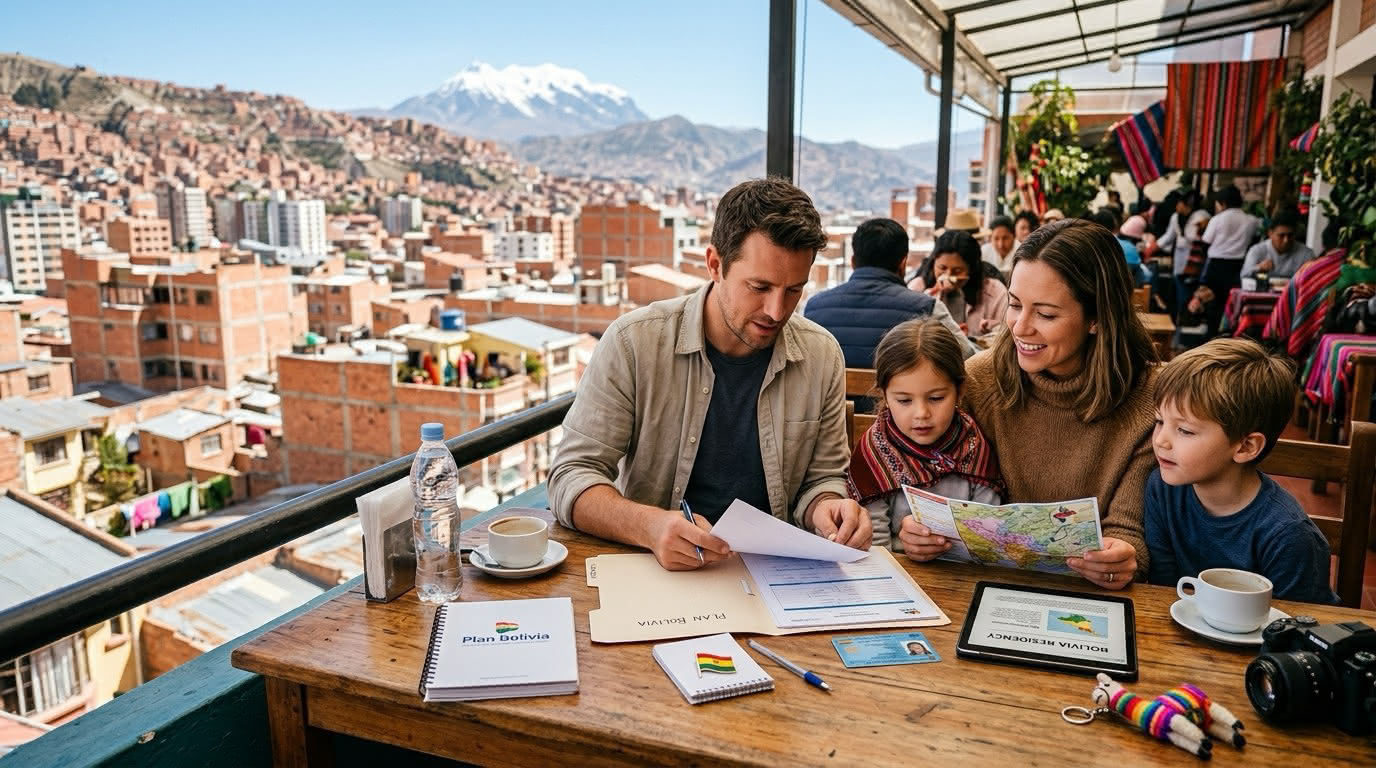
You arrive in Bolivia as a tourist (or your consular entry category). Most Western passport holders can file as soon as local documents are ready; some nationalities must wait 15 days first. The visa is often issued the same day in La Paz or Santa Cruz; the CIE at SEGIP completes the loop, fastest when you finish SEGIP in La Paz. For many expats, that speed changes the whole equation. Most countries ask for apostilles, home-country criminal records, and months of paperwork. Bolivia asks for far less for the initial visa.
That does not mean Bolivia fits everyone. Some people love the low-document residency path, territorial taxation, and the purchasing power they get from foreign income. Other people struggle with the 90-day absence rule during temporary residency, capital controls, and a banking system that does not feel like Europe or the United States.
If you are weighing a relocation, you need a balanced view. Moving to Bolivia as an expat: pros and cons comes down to one central question: do Bolivia’s advantages line up with the way you live, earn, travel, and handle uncertainty?
If you want the legal process itself, start with Bolivia residency in 2026: complete step‑by‑step guide. For the lifestyle side, start here.

Big‑picture overview: who actually enjoys Bolivia long‑term
Bolivia works best for a specific type of expat. You tend to do well here if you earn outside the country, want a second residency without heavy document collection, and can spend meaningful time in Bolivia during the temporary residency years.
The strongest fit includes people such as:
- Remote workers with foreign clients
- Retirees with pension income
- Investors and people living on foreign-source income
- Crypto holders who want a jurisdiction with no wallet reporting requirement
- People who already use Paraguay and want a complementary base nearby
- Multi-flag planners who want a second residency for diversification
Bolivia gives this group a clear draw. The country taxes domestic income, not foreign-source income. Foreign investment returns, crypto gains, foreign rental income, pensions, and remote work for foreign clients are not taxed in Bolivia. You also do not need a personal tax ID unless you run a business inside Bolivia that generates domestic revenue.
The residency ladder also feels unusually direct. You can enter as a tourist and apply for a 1-year temporary visa with a passport, bank statements, a sworn statement, local medical certificate, Interpol records obtained in Bolivia, and a local address, once you meet your nationality’s timing rule (Group 1: no 15-day wait; Groups 2/3: from day 16). You do not need an apostilled birth certificate or a home-country criminal record for that first year.
Some expats also prefer the 3-year route. If you form a Bolivian SRL and get a services contract from that company, you can apply for a 3-year temporary residency from the start. That path suits people who already know they want to stay and want to avoid the year-one renewal.
Bolivia fits less well if your life depends on frequent long absences. During temporary residency, you get 90 days outside Bolivia per calendar year by default. You can apply for an extension of up to another 90 days (180 total per calendar year) before the first 90 expire, but approval is not automatic and depends on the justification you provide. If you break continuity and your temporary visa is cancelled, your three-year clock toward permanent residency resets.
Bolivia also fits less well if you expect polished financial infrastructure. The country has capital controls and dollar scarcity. If you want banking that feels routine by US or European standards, Bolivia may frustrate you.
Cost of living: housing, food, transport and healthcare
Bolivia’s strongest financial appeal does not come from a published expat budget. It comes from the combination of territorial taxation, a straightforward residency path, and the gap between the official exchange rate and the blue market rate. For someone earning in dollars or crypto, that gap can create strong local purchasing power.
Bolivia’s official exchange rate sits at Bs 6.96 per dollar, while the parallel rate has been around Bs 9.00 to 9.50 (March 2026), with daily fluctuation. The rate once peaked far higher and has improved under the current government. If your income lands in dollars, euros, or crypto, daily expenses feel lighter than they would in many neighboring countries.
On the immigration side, many people who arrange a local lawyer themselves pay about:
- La Paz, around $1400 in legal fees per person
- Government and admin fees, around $400
- Cédula fee, Bs 600, around $65 at the blue rate
- Total, around $2,100 to $2,200 per person in La Paz
Santa Cruz tends to cost more, around $2,400 to $2,500 total. The visa itself is now issued the same day in both cities, but the total timeline runs longer in Santa Cruz because the cédula step at SEGIP takes about 15–25 days there versus 1–5 days in La Paz. Many expats process in La Paz, get the cédula, then move on. If you compare DIY local-lawyer spending with a fixed bundled service, DIY often ends up costing more than expected once you count coordination, logistics, and repeat trips. PlanBolivia.com offers a fixed all-in residency service, and you can See pricing and packages.
Things are surprisingly easy and affordable in Bolivia:
- Foreign income can stretch further because of the exchange-rate situation
- In La Paz, you can often use an Airbnb-style address for the initial residency process; Santa Cruz needs a written agreement identifying the property owner, a recent electricity bill, and a copy of the owner's ID, Airbnb still works there, with no formal lease or Folio Real required for the typical filing
- In La Paz, you do not need a formal long-term lease to start the typical filing
- You can change your address later by updating the immigration system
That setup helps many expats lower risk. You can enter, complete local steps (and any mandatory wait for your passport group), process your visa, and test the country before you commit to a longer housing arrangement.
Healthcare also enters the visa process early. You must obtain a medical certificate in Bolivia, and that usually takes around three days. That does not tell you the quality of every clinic or hospital, but it does show one practical point: the system can process required medical checks fast enough to fit the one-week residency timeline in La Paz.
Culture, language and day‑to‑day life shocks
Most expats do not struggle because Bolivia lacks something. They struggle because daily life feels less pre-packaged than what they knew before. Bolivia offers a more direct, less filtered environment. Some people read that as authenticity. Others read it as friction.
One practical shock comes from place and altitude. La Paz processing is faster and cheaper than Santa Cruz, but La Paz sits at 3,640 meters. Many people can tolerate that for the short processing window, then leave for a lower-altitude base.
Another adjustment comes from paperwork culture. Bolivia’s first-year residency process is light by regional standards, but it still runs on in-person steps. You need a local address (in La Paz, door photo and host details; in Santa Cruz, a written agreement identifying the owner, electricity bill, and copy of the owner's ID, Airbnb still works), medical certificate, Interpol records, a notarized sworn statement, and immigration appointments. A lawyer can accompany you to almost everything, but you still need to show up physically.
Language also affects daily ease. The official residency process relies on local institutions, local medical providers, local notaries, immigration offices, and local police or Interpol channels. An English-speaking expat with no Spanish support will feel more strain than someone who arrives with a lawyer, a fixer, or basic Spanish ability.
Even with support, Bolivia does not cater to foreign residents in the way some larger expat hubs do. You should expect to solve practical tasks directly. That includes:
- Collecting host or landlord details for your address file (or lease and title evidence if you file in Santa Cruz)
- Keeping track of renewal timing, ideally three months before expiry
- Arranging a company if you want a 3-year visa or year-two renewal
- Passing a driving test if you want a local driver’s license after you get your cédula
That style of life suits people who do not need constant hand-holding. It also suits people who enjoy a country before large-scale foreign demand smooths and prices it.

Pros: affordability, authenticity, opportunities
Bolivia gives expats several concrete advantages, and these advantages are strong enough to outweigh the rough edges for the right person.
- Fast residency process. In La Paz, the process can move from day 15 after entry to visa issuance in a day, with the cédula the next day.
- Low document burden. For the 1-year visa, Bolivia does not require a birth certificate, a home-country criminal record, or apostilles.
- No company required for year one. You can qualify with a sworn statement and financial proof.
- Territorial taxation. Bolivia taxes domestic income, not foreign-source income.
- Useful national ID. The cédula allows bank accounts, exchange access, legal representation for a company, and a driver’s license application.
- 3-year route available. If you form an SRL and hire yourself through a services contract, you can skip the one-year renewal cycle.
- Dual citizenship allowed. Bolivia recognizes dual nationality.
- Crypto remains lightly regulated. There is no wallet reporting requirement and no specific crypto capital gains tax for individuals mentioned in the source material.
- No CRS or CARF implementation as of March 2026. Bolivian banks do not automatically share account information with foreign tax authorities under CRS because Bolivia has not implemented it.
There is also a broader timing advantage. The current government has moved in a pro-market and pro-foreign-investment direction, advanced bills in Congress to repeal several taxes, including the IGF (wealth tax); as of March 2026 that repeal is not yet enacted and the IGF remains formally in force. The administration has also restored US relations, approved Starlink, and shifted the US and South Korea into Group 1 for visa-free tourist entry. If that direction continues, Bolivia may become more attractive and more formalized at the same time. Early movers usually benefit from systems before demand catches up.
The company option also creates flexibility. An SRL requires two partners, allows foreign partners by power of attorney, needs minimum capital of Bs 200, and can usually be formed in one to two weeks. If the company stays clean, with no employees, debts, or tax activity, closure can also be straightforward.
Cons: bureaucracy, infrastructure gaps, adaptation challenges
Bolivia’s upside does not erase the constraints. If you move here, you need to accept the country on its own terms.
- Strict absence rules during temporary residency. You cannot structure a Bolivia residency around long periods abroad unless you manage extensions carefully.
- Banking limitations. Bolivia has capital controls and dollar scarcity. People who need mature banking infrastructure may struggle.
- Domestic business limits. If you want to earn significant income inside Bolivia, domestic tax and employment rules matter. The source material notes 25% corporate tax on domestic income and a foreign employee cap.
- Renewal pressure. If you start with the 1-year visa, the sworn-statement option is not available for renewal. Year 2 and beyond require a services contract from a Bolivian company, a labor contract, NIT registration as an independent or remote business, or a family-based renewal, and you should begin renewal around three months before expiry.
- Physical presence requirements. Immigration still requires in-country time, appointments, and local document collection.
- Altitude in La Paz. The faster processing city can feel uncomfortable, especially if you are sensitive to high elevation.
There are also facts that should make you pause before moving for the wrong reasons. The country does not suit people who want to spend most of the year elsewhere while keeping temporary residency alive. It also does not suit people who expect to arrive and replicate a high-service expat bubble from day one.
Even the 3-year visa route requires setup. You need a Bolivian company, the company must be a local entity, and the legal representative must hold a cédula. That creates a sequence to manage, even if the result is cleaner than annual renewal.
Bolivia is a practical option with a strong residency proposition and a list of frictions that some people can tolerate and others cannot.
Who should strongly consider Bolivia (and who should not)
You should look closely at Bolivia if you fit several of these points:
- You earn abroad and want territorial taxation
- You want residency without collecting apostilles and home-country police records for the first visa
- You can spend enough time in Bolivia to protect your temporary residency continuity
- You want a cédula that lets you bank, contract, and operate locally
- You want a second base near Paraguay
- You are comfortable with some administrative friction in exchange for a lighter immigration system
You should think twice if you fit several of these:
- You need to stay outside Bolivia for more than 90 days at a time during temporary residency
- You want banking and dollar access that feel routine by US or European standards
- You plan to earn your main income inside Bolivia and want a low-friction local corporate setup
- You dislike in-person paperwork, local process variation, and adaptation pressure
- You need a polished expat ecosystem from the start
For many expats, Bolivia works best as a deliberate choice, not an impulse move. The country gives you a fast path to legal presence, a practical national ID, and a tax model that suits foreign income. In exchange, Bolivia asks for time on the ground, patience with process, and realistic expectations about infrastructure.
Want to map your next step? Read Moving Family to Bolivia: Schools, Costs & Safety or Bolivia Real Estate: Rent vs Buy in 2026, then get in touch when you're ready. You can also see pricing and packages.
Frequently Asked Questions
Who is Bolivia a strong fit for as an expat?
Bolivia tends to suit people with foreign-source income, such as remote workers, retirees, investors, and crypto holders. It also fits people who want a lighter residency process and can spend enough time in Bolivia during temporary residency.
What makes Bolivia attractive compared with other residency options in the region?
Bolivia offers a fast initial residency process, low document burden, and territorial taxation. For the 1-year visa, applicants do not need apostilled birth certificates or home-country criminal records.
What are the main drawbacks of living in Bolivia as an expat?
The main constraints are the 90-day absence limit during temporary residency, capital controls, dollar scarcity, and banking infrastructure that may feel limited compared with Europe or the United States. Some expats also find the in-person paperwork and adaptation process tiring.
How much does the initial residency process usually cost?
People who hire a local lawyer themselves often spend about $1,100 to $1,200 per person in La Paz, including legal, government, and cédula fees. Santa Cruz can cost more and may take longer.
Can foreign income be taxed in Bolivia if I move there?
Bolivia uses a territorial tax system, so only income generated inside Bolivia is taxed. Foreign-source income, including pensions, investment returns, crypto gains, foreign rental income, and remote work for foreign clients, is not taxed in Bolivia.