By Frank G. & Edwin H.
Bolivia's dollar crisis: why crypto took over

In May 2025, the Bolivian boliviano was dying in public.
The official exchange rate said one US dollar was worth 6.96 bolivianos. That was the government's rate. The rate on every state document, every bank form, every customs declaration.
On the street, one US dollar was worth 20 bolivianos. Nearly triple. And you still couldn't get one, because there were none.
Bolivia had run out of dollars.

How a country runs out of money
For fourteen years, Bolivia kept its currency pegged at 6.96 BOB per dollar. That peg needed dollars. Lots of them. Every time someone wanted to convert bolivianos to dollars, the central bank had to hand them over, or the peg would collapse.
For a while, the math worked. Bolivia exported natural gas, which gave them fresh dollars and the peg held. Inflation stayed near zero. The boliviano was one of Latin America's most stable currencies.
Then the gas dried up. Production fell year after year. Gas exports collapsed by over 60 percent due to underinvestment and poor management. Dollar inflows dried up. And the central bank kept defending the peg, burning through reserves to keep the official rate alive on paper.
In 2014, Bolivia had a whopping $15 billion in foreign reserves. By August 2025, after years of socialism, it had $171 million. A 98 percent drop. The peg was still officially in place, but the dollars behind it were not.
When those numbers became bad enough to be visible, a parallel market appeared. People who needed dollars couldn't get them from banks, so they bought them from someone who did still have them. That someone of course charged a premium, which kept growing and growing.
By May 2025, the premium was basically 200 percent.
Import companies couldn't get dollars to pay foreign suppliers, resulting in shortages of medicine and fuel. Car dealers sat on demand for inventory they couldn't restock. Credit cards were limited to $35 per month for international purchases. Savers watched their dollar deposits get returned to them in bolivianos at the official rate, which meant losing 40 percent of their value the moment they withdrew them.
Bolivia wasn't poor, but it certainly was running out of the things it needed to function.
The dollar that didn't need to exist
Something unexpected happened in this collapse. Bolivians stopped waiting for dollars that weren't coming and started using a dollar that didn't need a central bank to exist.
USDT. Tether. A stablecoin pegged one-to-one to the US dollar, issued on blockchains, transferable peer-to-peer, and uncensorable by any Bolivian institution.
The government had banned crypto for years. In June 2024, that ban was lifted. The timing was accidental but the effect was enormous. At the exact moment the dollar was disappearing from the banking system, a digital dollar became legal. A coincidence that protected the people of Bolivia from a lot of trouble.
Adoption went vertical. Crypto transaction volume in Bolivia rose from $46.5 million in 2024 to $294 million in the first half of 2025 alone. A 630 percent increase. Daily USDT liquidity on small local platforms went from around $20,000 to nearly $1 million.
What was USDT being used for? Almost everything a dollar used to do.
Importers bought USDT from local sellers, transferred it to international suppliers, and kept supply chains alive. Savers parked their earnings in USDT to stop watching their purchasing power evaporate. Car dealers, starting with Toyota, Yamaha, and BYD, began accepting USDT payments directly because they couldn't get dollars any other way to pay for the vehicles they imported. The state energy company, YPFB, started using crypto for energy imports.
By late 2025, menus in some urban areas were priced in USDT. Small businesses. Restaurants. Barbershops. The stablecoin had quietly become Bolivia's shadow dollar, which saved the day for Bolivians who had nothing to do with their government's poor checkbook-balancing skills.
Two tools, two jobs
USDT wasn't the only thing Bolivians were using. Bitcoin came along for the ride, and it did a different but equally important job.
The pattern that emerged looked almost designed. Bolivians used stablecoins for stability and pricing, and Bitcoin for international transfers, savings that didn't need to be linked to the dollar, and everyday payments where Lightning made small transactions practical.
Christopher Salas runs a small coffee stand in La Paz. He accepts Bitcoin via Lightning through a Blink wallet QR code. In his words, he's not the only one. A barbershop down the street accepts satoshis. So does a gym. The same thing is happening in Cochabamba, where crypto ATMs have appeared, beauty salons offer discounts for Bitcoin payments, and Binance accounts buy restaurant meals.
The Colombian wallet provider Meru reported a 6,600 percent increase in Bolivian accounts after the ban was lifted. That's Bitcoin infrastructure showing up in a country that, a year earlier, had treated it as illegal.
The split of tools makes sense when you look at what each one does well.
Stablecoins are good at being dollars. They hold value against a familiar benchmark, they settle fast, and they let a business price goods predictably. If you need to pay a Chinese supplier next week and you need the number to still mean something, you use USDT.
Bitcoin is different. It doesn't track the dollar, which means it doesn't need any company's balance sheet to work. It settles globally without a counterparty. On Lightning, it handles transactions of a dollar or two without fees eating the payment. And it has no issuer who can freeze your wallet.
For a country where the sovereign currency had just failed, both tools were useful. Stablecoins covered the day-to-day. Bitcoin covered what stablecoins can't: the exit option.

What actually stabilized the boliviano
Here's where the story gets interesting, and where the headline everyone wants to write gets it slightly wrong.
The parallel rate came down from 20 to 9.5. Crypto played a role. But it wasn't crypto that fixed the currency.
The rate started falling in July 2025, when polls signaled that Bolivia's long-ruling socialist party was about to lose the presidential election. The rate fell further in August when the first round confirmed it. It fell again in October when Rodrigo Paz won the runoff. And it stabilized around 9 to 9.5 after the new government announced it would abandon the artificial peg and move to a floating exchange rate, eliminate fuel subsidies, and engage the IMF.
That's what stabilized the boliviano. A political pivot to someone more likely to keep a checkbook balanced, policy credibility, and the market's belief that Bolivia was finally going to stop pretending.
So what did USDT and Bitcoin actually do?
They kept the country running.
During the period from 2023 to late 2025, when the currency was broken and the political system hadn't yet corrected course, Bolivia needed to keep importing, keep trading, keep transacting, keep saving. The official dollar supply couldn't support any of this. The parallel dollar market was unstable and insufficient. Crypto and blockchain technology filled the gap.
Without USDT and Bitcoin, the shortage would have been worse. Supply chains would have broken harder. Inflation would have spiked higher than the 22 percent average it actually reached. More businesses would have shut. More savings would have evaporated. The crisis would have been deeper, and the eventual political correction would have happened under more desperate conditions.
This is the real story. Crypto didn't save the currency. Crypto saved the economy around the currency while the government's fiat was collapsing.
Why this matters beyond Bolivia
Most sovereign currency crises in the 20th century played out the same way. The currency fails, the population has no alternative, suffering compounds, and eventually the government reforms or collapses. The population is trapped inside the failing money.
Bolivia is one of the first major cases of a country exiting that trap through peer-to-peer digital money. Not through IMF loans, not through dollarization by decree, not through black market cash smuggling. Through USDT and Bitcoin on blockchains.
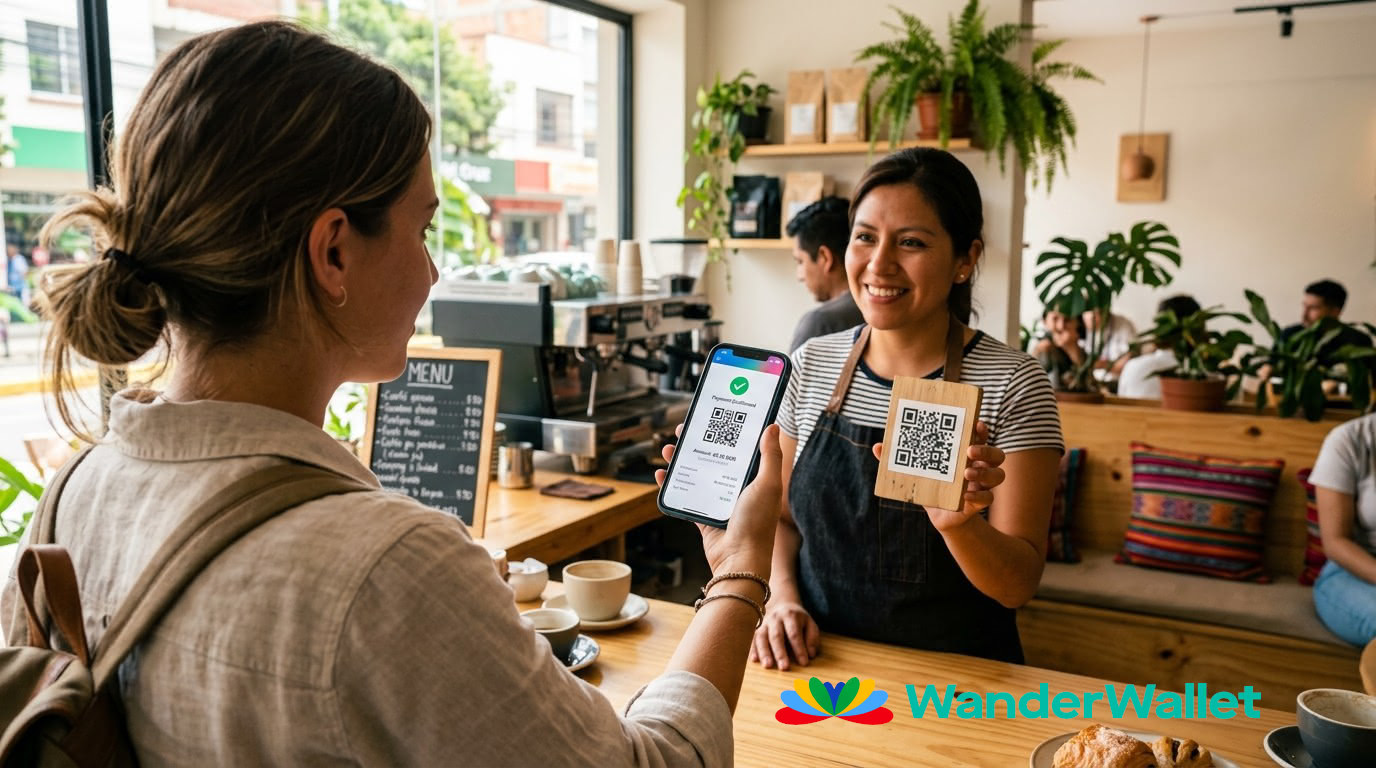
The infrastructure already existed. Binance P2P. Bolivia's regulated Banco Bisa with its CriptoBisa custody service. Toyota QR codes powered by Tether and BitGo. Services like WanderWallet that let someone holding USDT pay directly into Bolivia's QR payment system, no Bolivian bank account required (read about our recent WanderWallet collaboration). Coffee stands running Lightning invoices. Ordinary Bolivians with phones and wallet apps. No government had to build any of it. No one had to approve it. It just worked. People built this. The crypto community.
That's the new thing in the world. A monetary system that can function in parallel to, or in place of, a failing sovereign one, without anyone's permission. It makes Bolivia a surprisingly resilient and safe place to call home.
Here's the part that should make Bitcoiners pay attention.
USDT is not neutral money. It's a private company issuing a dollar-backed token. It can be frozen. It can be censored. Tether has complied with law enforcement requests before and will again. The coffee stand running Lightning does not have that problem. The Bitcoin held in a self-custody wallet does not have that problem.
Bolivia was partly saved by a stablecoin whose issuer could, in theory, turn its wallets off. And it was partly saved by Bitcoin and its strong community, both of which no one can turn off.
The next country to go through what Bolivia just went through will look at this story and have a choice. Build the escape route on infrastructure you control, or on infrastructure controlled by a company. Bolivia used both. It worked. But the Bitcoin half of the solution is the half that keeps working even if the political weather changes again.
Where Bolivia goes from here
The Paz government is now integrating stablecoins into formal banking. Banks can custody digital assets. Crypto-linked savings accounts are being developed. Credit cards backed by stablecoins are already in circulation. USDT is moving from underground infrastructure to part of the official financial system. Bitcoin is along for the ride, growing quietly in the places it was already strongest: peer-to-peer payments, international transfers, and long-term savings for people who no longer trust any government's currency, including their own.
Inflation is still high and the political picture is still fragile. Bolivia isn't fixed. But it's standing, and it's standing partly because a technology most of the world still thinks of as speculative turned out to be the thing that kept the lights on.
For expats, nomads, and crypto holders watching from outside, Bolivia is now one of the clearest real-world examples of what happens when programmable money meets a broken currency. Not a theory on X, but a country whose population walked the walk when it mattered most.
For a deeper look at how this plays out for foreign residents specifically, read Is Bolivia crypto-friendly? Laws, reality and risks, How Bolivia treats foreign income and tax residency, and CRS & CARF status in Bolivia.
Want to map your next step? Read Is Bolivia Crypto-Friendly? Laws, Banks & Risks or Bolivia Foreign Income Tax: What Residents Keep, then get in touch when you're ready. You can also see pricing and packages.
Frequently Asked Questions
Is crypto legal in Bolivia?
Yes. Bolivia lifted its long-standing crypto ban in June 2024. Since then, regulated banks like Banco Bisa offer USDT custody, and a presidential decree in November 2025 authorized all banks to provide crypto custody, savings, credit cards, and loans backed by digital assets.
Why did Bolivia run out of US dollars?
Bolivia spent roughly fourteen years defending an artificial peg of 6.96 BOB per dollar while gas exports, the country's main source of dollar inflows, collapsed by more than 60 percent. The central bank burned through reserves to keep the peg alive on paper, dropping from $15 billion in 2014 to $171 million by August 2025.
What is the parallel exchange rate in Bolivia today?
The parallel rate peaked around 20 BOB per USD in May 2025 and has since stabilized around 9 to 9.5 BOB per USD after the new Paz government signaled a move to a floating exchange rate, fuel subsidy reform, and IMF engagement.
How do Bolivians use USDT and Bitcoin in daily life?
Importers buy USDT to pay foreign suppliers. Savers park bolivianos in USDT to preserve purchasing power. Toyota, Yamaha, and BYD dealerships accept USDT for vehicles. Coffee stands, barbershops, and gyms in La Paz and Cochabamba accept Bitcoin via Lightning. Services like WanderWallet let foreigners spend USDT through Bolivia's QR Simple network without a Bolivian bank account.
Are crypto gains taxed in Bolivia?
Bolivia operates a territorial tax system. There is no capital gains tax for individuals on foreign-source crypto income, no CRS reporting, and no wallet reporting. For the full picture, see our guides on Bolivia's tax treatment and CRS & CARF status.